Sponsored

🔴💊 Engine Oil Red Pill Thread: Only Post If You Have UOA - Official Honda Civic Type R K20C1 Engine Oil Analysis

Ktrw

Senior Member
First Name
Zach
Joined
Mar 25, 2024
Threads
0
Messages
127
Reaction score
194
Location
United States
Vehicle(s)
2025 Integra Type S
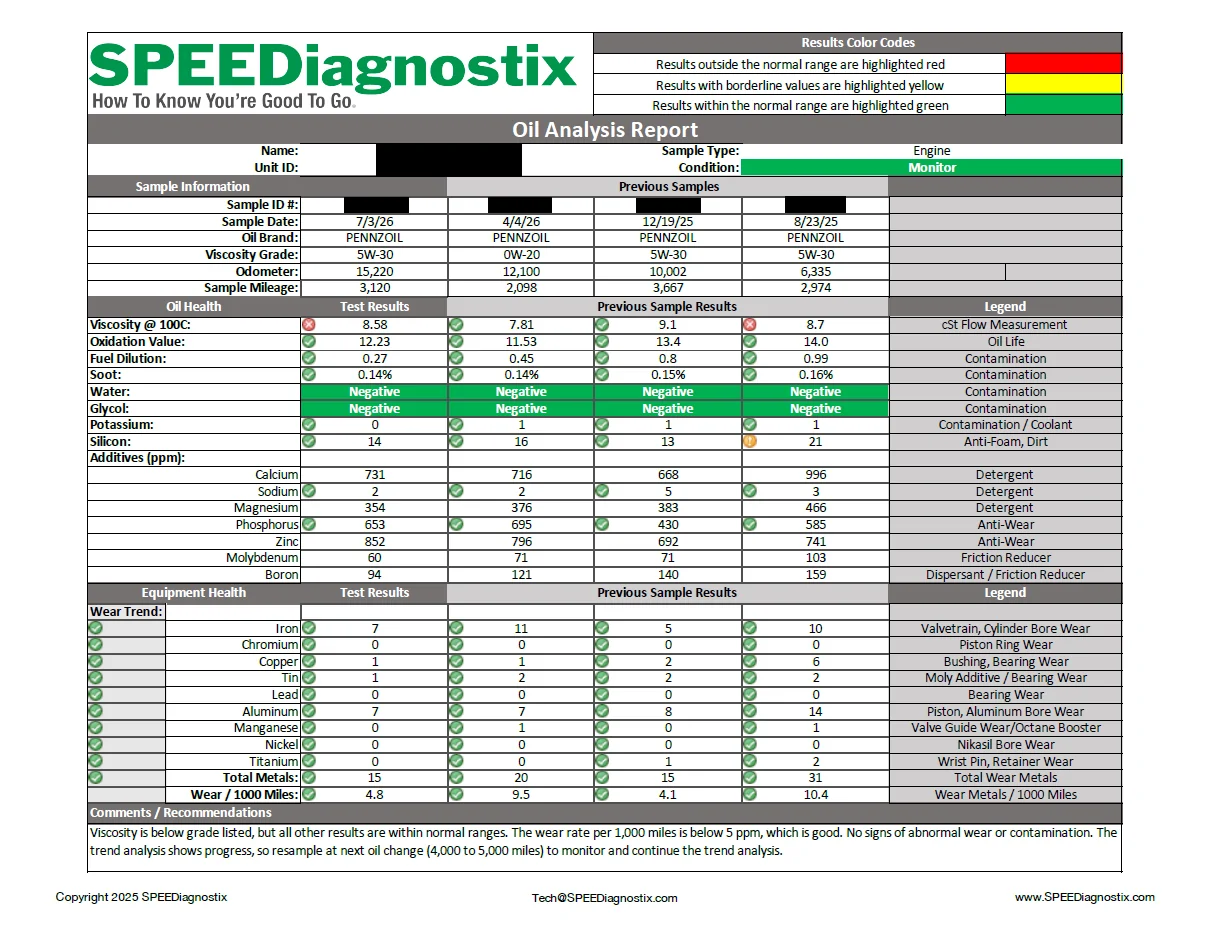
Got my last UOA back (PUP 5W-30 API SQ formulation) and I am happy the results are trending in the right direction again. The viscosity was low, likely due to residual 0W-20 from the last oil change, but my wear metals are back down below 5ppm/1k miles, so that is nice to see.
I was hoping to buy some Honda Formula R by now, but I ended up increasing my stockpile of Pennzoil Ultra Platinum for the time being since it's still not really available and potentially really expensive, as some members have mentioned.
Silicon and therefore the filtration of the PRL intake doesn't seem to be a problem as some folks have worried about on the FL5/DE5 forums. I'm now running the AEM dry flow filter to see if there is any difference.
My fuel dilution is now the lowest it's ever been, even with some short tripping. The oil still smells heavily of fuel as always (nothing new on my car), but maybe that's remnants of fuel hanging around after most of it evaporates or something.


11th Gen Honda Civic 🔴💊 Engine Oil Red Pill Thread: Only Post If You Have UOA - Official Honda Civic Type R K20C1 Engine Oil Analysis DE5 UOA 6
Sponsored

 
OP
OP
johnloov

johnloov

Senior Member
First Name
John
Joined
Jul 9, 2024
Threads
3
Messages
398
Reaction score
411
Location
USA
Vehicle(s)
FL5
It's looking really clean, those 2-3k oil change intervals are the key to long life.

Are you tracking your car, or have any mods? What's your driving behavior, short drives, only long drivers, etc. Engine mods - Would appreciate the detail to get a clear picture.

-----------

I did run this through AI to see what it thinks - Don't shoot the messenger - let me know where you agree disagree, I am open to changing my mind based on the data.

Yes — I remember the three datasets from this thread, and now we can compare them properly:

  1. Your FL5: Pennzoil Ultra Platinum 0W-20, 2,111 miles, 3 track days.
  2. Friend #1: Valvoline VR1 10W-30, 1,976 miles, tracked, rebuilt turbo, ACL race bearings.
  3. Friend #2: SPEEDiagnostix history with multiple Pennzoil 0W-20 and 5W-30 intervals.
The most important warning is that these are not perfectly controlled A/B tests. Different cars, drivers, track exposure, ambient temperatures, engine modifications, and laboratories affect the results. But the viscosity and wear trends are still extremely useful.

Current-sample comparison
Owner / oilOil milesUsed KV100Original grade retained?Fuel dilutionSiliconIronAluminumCopperLeadTotal wear metalsWear/1,000 mi
You — PUP 0W-202,1117.19 cStYes, SAE 20<0.5%124510about 10about 4.7
Friend #1 — VR1 10W-301,9768.23 cStNo, sheared to SAE 20<0.5%438819about 27+about 13.7+
Friend #2 — Pennzoil 5W-303,1208.58 cStNo, sheared to SAE 200.27%147710154.8
Immediate conclusion
Your oil finished thinnest at 7.19 cSt, but your engine produced the cleanest overall wear picture.

Friend #2’s 5W-30 finished at 8.58 cSt, which is thicker than your used 0W-20, but it still dropped below the SAE 30 cutoff of 9.3 cSt.

Friend #1’s VR1 10W-30 finished at 8.23 cSt, also becoming a 20-weight, while showing substantially more wear metals and contamination.

So the scientific conclusion is:

A thicker grade can finish thicker than 0W-20 yet still fail to remain in its intended grade. Used viscosity alone does not determine engine wear.

Friend #2’s complete history
The new SPEEDiagnostix report is particularly valuable because it follows the same engine over four intervals.

Sample dateOilMiles on oilUsed KV100Stayed in grade?FuelSiliconTotal metalsWear/1,000 mi
8/23/25Pennzoil 5W-302,9748.70No, SAE 200.99%213110.4
12/19/25Pennzoil 5W-303,6679.10No, just below SAE 300.80%13154.1
4/4/26Pennzoil 0W-202,0987.81Yes, SAE 200.45%16209.5
7/3/26Pennzoil 5W-303,1208.58No, SAE 200.27%14154.8
This is fascinating because the same 5W-30 oil family produced dramatically different wear rates:

  • 10.4 ppm/1,000 miles
  • 4.1 ppm/1,000 miles
  • 4.8 ppm/1,000 miles
That tells us engine operating conditions dominate many outcomes:

  • track duration and intensity
  • oil temperature
  • ambient temperature
  • warm-up cycles
  • previous residual oil
  • engine break-in or stabilization
  • driving style
  • sample collection method
The front label alone cannot explain the result.

Your result versus Friend #2’s best result
Your result:

  • approximately 4.7 ppm wear metals per 1,000 miles
  • 3 track days
  • 7.19 cSt
  • virtually no fuel dilution
  • very low insolubles
  • excellent silicon
  • zero lead
Friend #2’s best 5W-30 interval:

  • 4.1 ppm wear metals per 1,000 miles
  • 9.10 cSt
  • 0.80% fuel
  • total wear metals 15
  • oil barely missed SAE 30
Those results are effectively in the same excellent category. Friend #2’s 5W-30 had more remaining viscosity, but your engine showed similarly low normalized wear.

There is no evidence here that your engine was suffering because it used 0W-20.

Your result versus Friend #2’s 0W-20
MetricYour 0W-20Friend #2 0W-20
Oil mileage2,1112,098
Used viscosity7.197.81
Fuel dilution<0.5%0.45%
Iron411
Aluminum57
Copper11
Lead00
Total wear metalsabout 1020
Wear/1,000 milesabout 4.79.5
This is almost a perfect mileage comparison.

Your 0W-20 thinned more, but your engine generated roughly half the normalized wear metals.

That is powerful evidence that:

KV100 viscosity retention and wear metals do not correlate perfectly over a short interval.

Your engine may have:

  • lower actual oil temperature
  • better air filtration
  • fewer cold starts
  • different track intensity
  • better engine condition
  • more stable bearing clearances
  • different oil batch or residual fill
  • more favorable sampling
Why all the 30-weights fell into SAE 20
Friend #2’s Pennzoil 5W-30 samples ended at:

  • 8.70 cSt
  • 9.10 cSt
  • 8.58 cSt
All three were below the nominal SAE 30 minimum of 9.3 cSt.

That is a consistent pattern. It suggests one or more of:

  1. Permanent VII shear
  2. Fuel dilution
  3. Thermal degradation
  4. Mixing with residual thinner oil
  5. A fresh oil viscosity near the lower end of SAE 30 combined with normal service loss
Fuel dilution was only 0.27–0.99%, so fuel contributed, but likely does not explain all the viscosity loss.

The K20C1 appears to be very effective at pushing fuel-economy 5W-30 oils toward the upper SAE 20 range under this person’s usage.

What this says about 5W-20
These reports strengthen the case for your proposed Pennzoil Ultra Platinum 5W-20.

Why?

Your PUP 0W-20 starts at 8.8 cSt and ended at 7.19 cSt.

PUP 5W-20 also starts at 8.8 cSt, but has a slightly narrower multigrade spread. It might retain viscosity somewhat better, while producing almost identical oil and coolant temperature behavior.

A realistic prediction for your PUP 5W-20 after a similar interval would be:

Possible used KV100Interpretation
8.0–8.5 cStExcellent retention
7.6–7.9 cStGood improvement over your 0W-20
7.2–7.5 cStEssentially same result as your 0W-20
6.9–7.1 cStStill technically SAE 20, but close to the lower boundary
Below 6.9 cStFell out of SAE 20; undesirable
Overall ranking of the actual reports
Best engine-health report:
Yours

Your report has:

  • lowest iron
  • lowest lead
  • low aluminum
  • low silicon
  • trace insolubles
  • high flash point
  • excellent fuel control
  • approximately 4.7 ppm wear per 1,000 miles
Best viscosity remaining:
Friend #2’s 5W-30 at 9.10 cSt

It barely missed SAE 30, but retained the most usable viscosity among these Pennzoil examples and had excellent normalized wear at 4.1 ppm/1,000 miles.

Worst overall current result:
Friend #1 VR1 10W-30

Not necessarily because VR1 is a bad oil. That engine has:

  • rebuilt turbo
  • ACL race bearings
  • elevated silicon
  • elevated lead
  • different mechanical baseline
It cannot fairly be blamed entirely on the oil. But the oil clearly did not stay SAE 30.

Final engineering conclusion
Across all three cars, the evidence says:

  1. Your 0W-20 protected extremely well despite thinning.
  2. Both VR1 10W-30 and Pennzoil 5W-30 frequently sheared into SAE 20.
  3. The 30-weights still finished thicker than your 0W-20, but did not necessarily produce less wear.
  4. Engine condition, contamination, oil temperature, and operating profile matter more than the winter grade alone.
  5. The best next experiment for your car remains PUP 5W-20, because it preserves your proven low-wear Pennzoil chemistry and thermal behavior while potentially improving shear retention modestly.
The most scientifically valuable next step is to run the same mileage and roughly three track days on PUP 5W-20, then compare directly against your own 0W-20 baseline. Your own engine is the correct control group.
 

Ktrw

Senior Member
First Name
Zach
Joined
Mar 25, 2024
Threads
0
Messages
127
Reaction score
194
Location
United States
Vehicle(s)
2025 Integra Type S
It's looking really clean, those 2-3k oil change intervals are the key to long life.

Are you tracking your car, or have any mods? What's your driving behavior, short drives, only long drivers, etc. Engine mods - Would appreciate the detail to get a clear picture.

-----------

I did run this through AI to see what it thinks - Don't shoot the messenger - let me know where you agree disagree, I am open to changing my mind based on the data.

Yes — I remember the three datasets from this thread, and now we can compare them properly:

  1. Your FL5: Pennzoil Ultra Platinum 0W-20, 2,111 miles, 3 track days.
  2. Friend #1: Valvoline VR1 10W-30, 1,976 miles, tracked, rebuilt turbo, ACL race bearings.
  3. Friend #2: SPEEDiagnostix history with multiple Pennzoil 0W-20 and 5W-30 intervals.
The most important warning is that these are not perfectly controlled A/B tests. Different cars, drivers, track exposure, ambient temperatures, engine modifications, and laboratories affect the results. But the viscosity and wear trends are still extremely useful.

Current-sample comparison
Owner / oilOil milesUsed KV100Original grade retained?Fuel dilutionSiliconIronAluminumCopperLeadTotal wear metalsWear/1,000 mi
You — PUP 0W-202,1117.19 cStYes, SAE 20<0.5%124510about 10about 4.7
Friend #1 — VR1 10W-301,9768.23 cStNo, sheared to SAE 20<0.5%438819about 27+about 13.7+
Friend #2 — Pennzoil 5W-303,1208.58 cStNo, sheared to SAE 200.27%147710154.8
Immediate conclusion
Your oil finished thinnest at 7.19 cSt, but your engine produced the cleanest overall wear picture.

Friend #2’s 5W-30 finished at 8.58 cSt, which is thicker than your used 0W-20, but it still dropped below the SAE 30 cutoff of 9.3 cSt.

Friend #1’s VR1 10W-30 finished at 8.23 cSt, also becoming a 20-weight, while showing substantially more wear metals and contamination.

So the scientific conclusion is:

A thicker grade can finish thicker than 0W-20 yet still fail to remain in its intended grade. Used viscosity alone does not determine engine wear.

Friend #2’s complete history
The new SPEEDiagnostix report is particularly valuable because it follows the same engine over four intervals.

Sample dateOilMiles on oilUsed KV100Stayed in grade?FuelSiliconTotal metalsWear/1,000 mi
8/23/25Pennzoil 5W-302,9748.70No, SAE 200.99%213110.4
12/19/25Pennzoil 5W-303,6679.10No, just below SAE 300.80%13154.1
4/4/26Pennzoil 0W-202,0987.81Yes, SAE 200.45%16209.5
7/3/26Pennzoil 5W-303,1208.58No, SAE 200.27%14154.8
This is fascinating because the same 5W-30 oil family produced dramatically different wear rates:

  • 10.4 ppm/1,000 miles
  • 4.1 ppm/1,000 miles
  • 4.8 ppm/1,000 miles
That tells us engine operating conditions dominate many outcomes:

  • track duration and intensity
  • oil temperature
  • ambient temperature
  • warm-up cycles
  • previous residual oil
  • engine break-in or stabilization
  • driving style
  • sample collection method
The front label alone cannot explain the result.

Your result versus Friend #2’s best result
Your result:

  • approximately 4.7 ppm wear metals per 1,000 miles
  • 3 track days
  • 7.19 cSt
  • virtually no fuel dilution
  • very low insolubles
  • excellent silicon
  • zero lead
Friend #2’s best 5W-30 interval:

  • 4.1 ppm wear metals per 1,000 miles
  • 9.10 cSt
  • 0.80% fuel
  • total wear metals 15
  • oil barely missed SAE 30
Those results are effectively in the same excellent category. Friend #2’s 5W-30 had more remaining viscosity, but your engine showed similarly low normalized wear.

There is no evidence here that your engine was suffering because it used 0W-20.

Your result versus Friend #2’s 0W-20
MetricYour 0W-20Friend #2 0W-20
Oil mileage2,1112,098
Used viscosity7.197.81
Fuel dilution<0.5%0.45%
Iron411
Aluminum57
Copper11
Lead00
Total wear metalsabout 1020
Wear/1,000 milesabout 4.79.5
This is almost a perfect mileage comparison.

Your 0W-20 thinned more, but your engine generated roughly half the normalized wear metals.

That is powerful evidence that:

KV100 viscosity retention and wear metals do not correlate perfectly over a short interval.

Your engine may have:

  • lower actual oil temperature
  • better air filtration
  • fewer cold starts
  • different track intensity
  • better engine condition
  • more stable bearing clearances
  • different oil batch or residual fill
  • more favorable sampling
Why all the 30-weights fell into SAE 20
Friend #2’s Pennzoil 5W-30 samples ended at:

  • 8.70 cSt
  • 9.10 cSt
  • 8.58 cSt
All three were below the nominal SAE 30 minimum of 9.3 cSt.

That is a consistent pattern. It suggests one or more of:

  1. Permanent VII shear
  2. Fuel dilution
  3. Thermal degradation
  4. Mixing with residual thinner oil
  5. A fresh oil viscosity near the lower end of SAE 30 combined with normal service loss
Fuel dilution was only 0.27–0.99%, so fuel contributed, but likely does not explain all the viscosity loss.

The K20C1 appears to be very effective at pushing fuel-economy 5W-30 oils toward the upper SAE 20 range under this person’s usage.

What this says about 5W-20
These reports strengthen the case for your proposed Pennzoil Ultra Platinum 5W-20.

Why?

Your PUP 0W-20 starts at 8.8 cSt and ended at 7.19 cSt.

PUP 5W-20 also starts at 8.8 cSt, but has a slightly narrower multigrade spread. It might retain viscosity somewhat better, while producing almost identical oil and coolant temperature behavior.

A realistic prediction for your PUP 5W-20 after a similar interval would be:

Possible used KV100Interpretation
8.0–8.5 cStExcellent retention
7.6–7.9 cStGood improvement over your 0W-20
7.2–7.5 cStEssentially same result as your 0W-20
6.9–7.1 cStStill technically SAE 20, but close to the lower boundary
Below 6.9 cStFell out of SAE 20; undesirable
Overall ranking of the actual reports
Best engine-health report:
Yours

Your report has:

  • lowest iron
  • lowest lead
  • low aluminum
  • low silicon
  • trace insolubles
  • high flash point
  • excellent fuel control
  • approximately 4.7 ppm wear per 1,000 miles
Best viscosity remaining:
Friend #2’s 5W-30 at 9.10 cSt

It barely missed SAE 30, but retained the most usable viscosity among these Pennzoil examples and had excellent normalized wear at 4.1 ppm/1,000 miles.

Worst overall current result:
Friend #1 VR1 10W-30

Not necessarily because VR1 is a bad oil. That engine has:

  • rebuilt turbo
  • ACL race bearings
  • elevated silicon
  • elevated lead
  • different mechanical baseline
It cannot fairly be blamed entirely on the oil. But the oil clearly did not stay SAE 30.

Final engineering conclusion
Across all three cars, the evidence says:

  1. Your 0W-20 protected extremely well despite thinning.
  2. Both VR1 10W-30 and Pennzoil 5W-30 frequently sheared into SAE 20.
  3. The 30-weights still finished thicker than your 0W-20, but did not necessarily produce less wear.
  4. Engine condition, contamination, oil temperature, and operating profile matter more than the winter grade alone.
  5. The best next experiment for your car remains PUP 5W-20, because it preserves your proven low-wear Pennzoil chemistry and thermal behavior while potentially improving shear retention modestly.
The most scientifically valuable next step is to run the same mileage and roughly three track days on PUP 5W-20, then compare directly against your own 0W-20 baseline. Your own engine is the correct control group.
So my usage includes no track days because I'm not cool (I would like to at some point). My DE5 is my daily so I do short trip it to the gym on some days, do long drives on the highway, and I absolutely rip it on some backroads. My backroads driving is similar to what I see some folks doing in Cali canyons, though I'm not crossing double yellows and what not.

My car is custom e-tuned by Drob since late April 2026 with full PRL bolt ons: charge pipes, intercooler, intake, turbo inlet pipe, and TSP downpipe. I think it's pretty cool that even though I'm probably making an additional 60-80hp over stock, my wear rate is still seemingly great.

Many tuners tend to recommend that you step up oil viscosity to the 30 grade range when tuned. I think a recent video from Lake:


Though for diesels, it provides some insights into when it may make sense to use a thicker oil. The K20C engine makes pretty good power from 3-7k rpm, with most of the torque ramping in even before 3k rpm. With that in mind, I think when tuned, there is a case for a thicker oil making sense to help seal the cylinder in the lower rev range, given the peak cylinder pressure around 3k rpm is analogous to that of a diesel engine. Lake basically showed that the cylinder ended up sealing better (higher peak torque values) around peak torque with thicker oils in the engine they used for testing, ranging from 0W-20 to 5W-40. Obviously, the thicker oils will lead to lower peak horsepower figures at higher rpm due to losses, but it's an interesting aspect to think about with some data to back it up.

Regarding what the AI is seeing from my results, there are some factors skewing what can be seen at face value, like the far-right sample occurring before 10k miles, so the wear metals were still elevated from break-in. Also, because I switched from 0W-20 to 5W-30, back to 20, and back to 30, there is some effect on the final viscosity of the used samples. Pretty cool to see Ben's VR1 result though, I've been thinking about trying 10W-30 at some point since it would be more shear stable than 5W-30.
 
Last edited:
OP
OP
johnloov

johnloov

Senior Member
First Name
John
Joined
Jul 9, 2024
Threads
3
Messages
398
Reaction score
411
Location
USA
Vehicle(s)
FL5
Great feedback. I agree if you have a tuned car, 5w-30 is the way to go at a minimum.

So far it seems that Motul has the most sheer stable engine oil in this forums results. My friend Eric used Motul Power 8100 5w/30 on his Type R - heavily tracked and used it daily, changed it every 5k miles and his Aluminum wear was similar in ppm to Pennzoil Ultra Platinum 5w-30 at ~2500-3000 miles - and someone else had Motul 0W-20 and it also was sheer stable. It seems congruent with what lake speed is saying recently.
 

cryptolime

Senior Member
Joined
Oct 21, 2023
Threads
50
Messages
698
Reaction score
354
Location
Wilmington, NC
Vehicle(s)
2023 Civic Si
Great feedback. I agree if you have a tuned car, 5w-30 is the way to go at a minimum.

So far it seems that Motul has the most sheer stable engine oil in this forums results. My friend Eric used Motul Power 8100 5w/30 on his Type R - heavily tracked and used it daily, changed it every 5k miles and his Aluminum wear was similar in ppm to Pennzoil Ultra Platinum 5w-30 at ~2500-3000 miles - and someone else had Motul 0W-20 and it also was sheer stable. It seems congruent with what lake speed is saying recently.
HPL oils are also extremely shear stable from the UOAs I've seen on BITOG forums
Sponsored


Top