
Sponsored

Downpipe Hard Lagging, Soft Lagging, and Coating Discussion

blueroadster

Senior Member
Joined
Apr 19, 2024
Threads
38
Messages
758
Reaction score
1,068
Location
MD
Vehicle(s)
2024 Civic Type R, 2026 Passport TSE, 2026 Pilot BE, 1964 Impala SS
In this thread from May of 2025, I considered adding hard lagging to the TSP downpipe after I had it coated by Swain Tech. Since the downpipe no longer had a bare metal surface to hard lag, I opted to install the removable PTP hybrid downpipe blanket instead. It was a great setup where the Swain Tech coating provided corrosive protection and a thick ceramic layer to help retain heat within the downpipe itself. Adding the PTP hybrid downpipe blanket on top of that resulted in a much more significant improvement in containing heat since it added a layer of thermal insulation.

Moving forward, I received the new SBX downpipe mentioned in this post. Since the tubular sections of the downpipe have a raw surface made of of 304 SS, I would like to reexplore the option of hard lagging the downpipe itself.

Question...I would like to add hard lagging onto the SBX downpipe that uses 304 SS tubular sections. From my limited understanding of galvanic reactions, it appears that a shell made of 304 or 321 SS would be ideal where 347 SS could also be used. Manufacturers that I have found thus far that offer hard lagging services include Header Shield (US) and Zircotec (UK).

Does anyone have experience in having their parts hard lagged? If so, what are your thoughts on durability and overall quality? Does one company stand out above the others?
Sponsored

 
Last edited:

OP
OP
blueroadster

blueroadster

Senior Member
Joined
Apr 19, 2024
Threads
38
Messages
758
Reaction score
1,068
Location
MD
Vehicle(s)
2024 Civic Type R, 2026 Passport TSE, 2026 Pilot BE, 1964 Impala SS
I phoned a friend that is a mechanical engineer to ask for his opinion on the topic. He loves what he does but absolutely hates interacting with stupid people. My ask made him question if I recently joined their camp. As a friend, he said that I should: (1) at least understand the basic fundamentals related to the ask and (2) suggested that I start by churching myself up on Bernoulli's principle and Boyle's law.
 

Cueyo

Senior Member
Joined
Nov 3, 2023
Threads
22
Messages
1,058
Reaction score
841
Location
USA
Vehicle(s)
2025 Civic Type R
I have my masters in mechanical engineering and work at an automotive design company. I can try to answer questions to the best of my ability. Please let me know what specifics I can help with.
Is it one of them Detroit yeehaw companies?

I phoned a friend that is a mechanical engineer to ask for his opinion on the topic. He loves what he does but absolutely hates interacting with stupid people. My ask made him question if I recently joined their camp. As a friend, he said that I should: (1) at least understand the basic fundamentals related to the ask and (2) suggested that I start by churching myself up on Bernoulli's principle and Boyle's law.
Lol this is the classic "you're not smart enough to talk to me response". I've personally witnessed it many times in meetings. Just another way to say "fuck off" 🤣

I was unfamiliar with the term "hard lagging", but if I understand correctly, it's just another form of coating, correct? Google tells me it involves wrapping specifically. Ive heard good things about zircotec, but depending on how much you want to spend, or could be worth it to just go the coating and wrapping with a thermal blanket route like last time.

I don't have exact experience with automotive insulation and wrapping, but plenty with piping for cooling and heating systems. I think you may just be better off asking the manufacturers how their product is better.
 
Last edited:
OP
OP
blueroadster

blueroadster

Senior Member
Joined
Apr 19, 2024
Threads
38
Messages
758
Reaction score
1,068
Location
MD
Vehicle(s)
2024 Civic Type R, 2026 Passport TSE, 2026 Pilot BE, 1964 Impala SS
Is it one of them Detroit yeehaw companies?


Lol this is the classic "you're not smart enough to talk to me response". I've personally witnessed it many times in meetings. Just another way to say "fuck off" 🤣

I was unfamiliar with the term "hard lagging", but if I understand correctly, it's just another form of coating, correct? Google tells me it involves wrapping specifically. Ive heard good things about zircotec, but depending on how much you want to spend, or could be worth it to just go the coating and wrapping with a thermal blanket route like last time.

I don't have exact experience with automotive insulation and wrapping, but plenty with piping for cooling and heating systems. I think you may just be better off asking the manufacturers how their product is better.
No, he is a really smart dude that was the chief engineer of a reputable automotive parts company. He used CAD to design parts from scratch where his machine shop included waterjet cutters, mandrel tubing benders, and robotic welders. He likes designing and building shit that actually works without having to interact with customers asking dumb questions that have no relationship to the part that he created. Such interactions interfere with designing the next solution/product he wants to make.

Hard lagging bonds a shield that includes a thermal insulation barrier with an exterior shell (commonly made out SS or Inconel) onto the part itself. As a result, it is not removable.

Soft lagging differs in that it is not bonded onto the part itself and is removable. Soft lagging comes in different forms. For example, the PTP hybrid downpipe blanket is very similar to a hard lagged option since it includes a metal-based exterior shell where the shield is removable. Removable lava blankets also fall into the soft lagged category.

Coatings are applied or bonded onto the part itself. Think of Cerakote, Swain Tech White Lightning, Zircotech ThermoHold, Jet-Hot, VHT Flameproof, etc. The primary function is to provide corrosion protection for the base metal of the part while also offering some thermal protection using ceramic in the coatings. They differ from hard or soft lagging since there is no layer of insulation.

I try to engage with manufacturers directly regarding the products that they are selling to better understand the function and problem intended to be solved. In the past, detailed part specifications were shared by manufacturers or design/technical questions readily answered so the customer could make an informed decision.
 
Last edited:


OP
OP
blueroadster

blueroadster

Senior Member
Joined
Apr 19, 2024
Threads
38
Messages
758
Reaction score
1,068
Location
MD
Vehicle(s)
2024 Civic Type R, 2026 Passport TSE, 2026 Pilot BE, 1964 Impala SS
I have my masters in mechanical engineering and work at an automotive design company. I can try to answer questions to the best of my ability. Please let me know what specifics I can help with.
Many thanks...I would like to add more context regarding thoughts before hitting you up directly with a question. In the interim, please chime in to offer thoughts and/or any course corrections along the way.
 
Last edited:
OP
OP
blueroadster

blueroadster

Senior Member
Joined
Apr 19, 2024
Threads
38
Messages
758
Reaction score
1,068
Location
MD
Vehicle(s)
2024 Civic Type R, 2026 Passport TSE, 2026 Pilot BE, 1964 Impala SS
Here are my observations of using the TSP downpipe (Raw) with a Swain Tech White Lightning coating and PTP hybrid turbo blanket:
  1. TSP downpipe (Raw): Offered a performance improvement by opening up the restrictive exhaust choke points on the OEM downpipe. It uses a "private label" version of the GESI 400-cell catalytic converter so no worries about a check engine light. It also uses girthy cast SS elbows on both ends where the overall part weight is slightly higher as compared to the OEM downpipe that it replaces. I ordered the Raw version of the TSP downpipe so I could have my choice of coating applied instead of the optional Cerakote offered;
  2. Swain Tech (White Lightning coating): Arguably the best and proven ceramic coating was added onto the TSP downpipe (Raw). Coating was thick (as compared to others) and bonded onto the base metal to offer corrosion protection and an initial layer of thermal protection. Note the comment on Swain Tech's page where the coating provides an ideal base to add an additional high-temperature paint to change the overall color. I would strongly recommend doing so to seal the surface area as the White Lighting coating itself will easily collect and show any dirt/smudges/oil residue on the surface;
  3. PTP hybrid downpipe blanket: Retains heat in the downpipe better than any other soft lagging option since it also includes an exterior metal shell. It is advertised as a hybrid since it functions the same as its hard lagged counterpart but is removable. Being removable, the overall thickness of the blanket is much greater as compared to the 0.25" thickness commonly used via hard lagging.
Fast forward...Numbers one and two were good choices. Number three was a bad one.
 
Last edited:

ModJPB

Senior Member
First Name
Jason
Joined
Jul 2, 2025
Threads
0
Messages
105
Reaction score
103
Location
07731
Vehicle(s)
2022 Civic Sport Touring Hatchback CVT Rallye Red
Me thinks you are over thinking this. "hard lagging"?!?.... It's just a heat shield. Look at the OEM design and mimick it. Heck take the OEM shields off and attach/weld them to the new downpipe. It's not a NASA shuttle nor is this supposed to last forever. The price you will pay to get this all done to your standards, you could just buy two more downpipes as they age and rot from proposed galvanic corrosion. Plus doing all that work on an aftermarket catalyst, which are notorious for short life spans, just seems inefficient. Why spend all this time, work, money, and research focusing on only the downpipe when you'll still get heat soak coming off the turbo and frontpipe? Go enjoy driving your car, stop worrying about the 0.0001% improvement you could have made.
 
OP
OP
blueroadster

blueroadster

Senior Member
Joined
Apr 19, 2024
Threads
38
Messages
758
Reaction score
1,068
Location
MD
Vehicle(s)
2024 Civic Type R, 2026 Passport TSE, 2026 Pilot BE, 1964 Impala SS
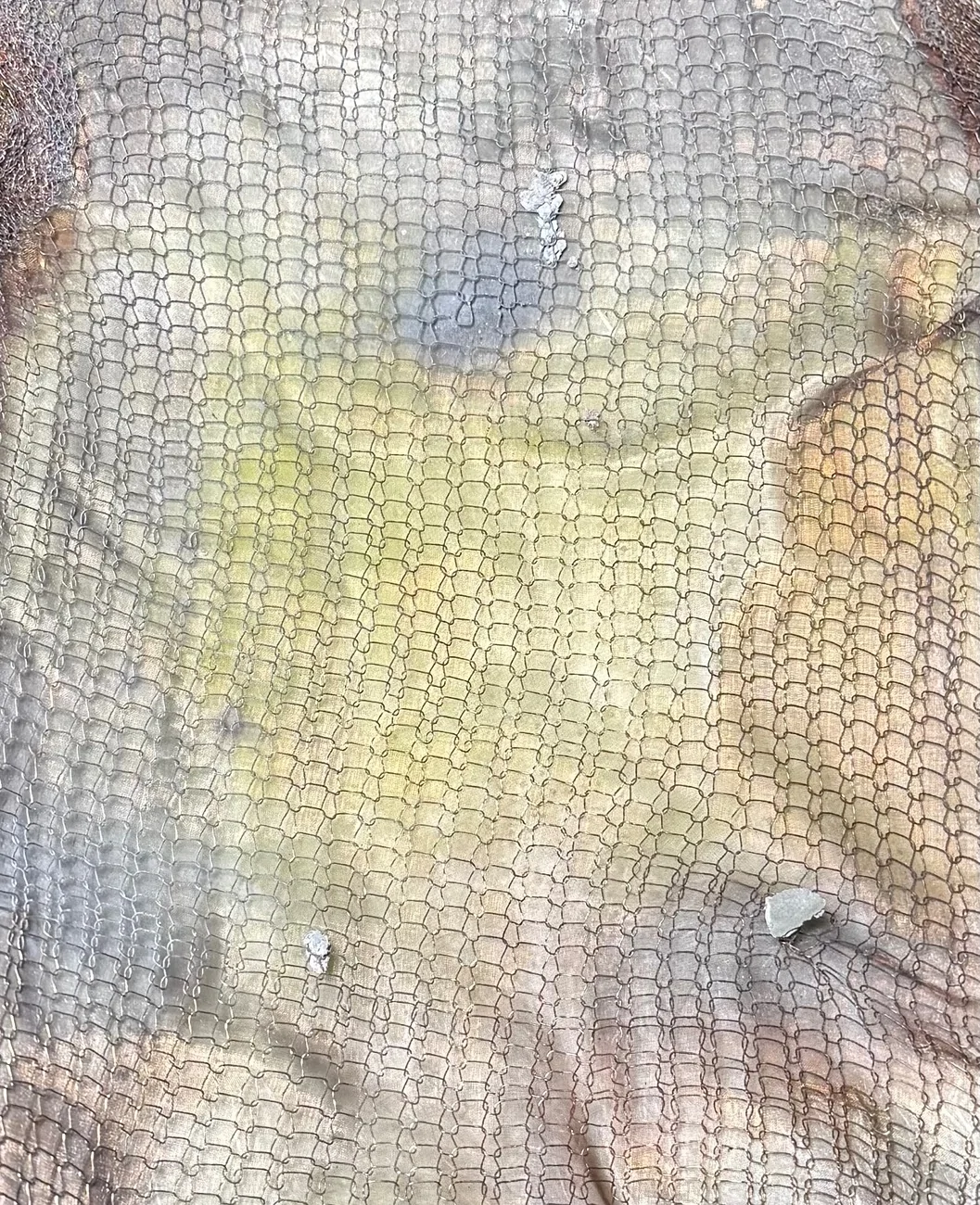
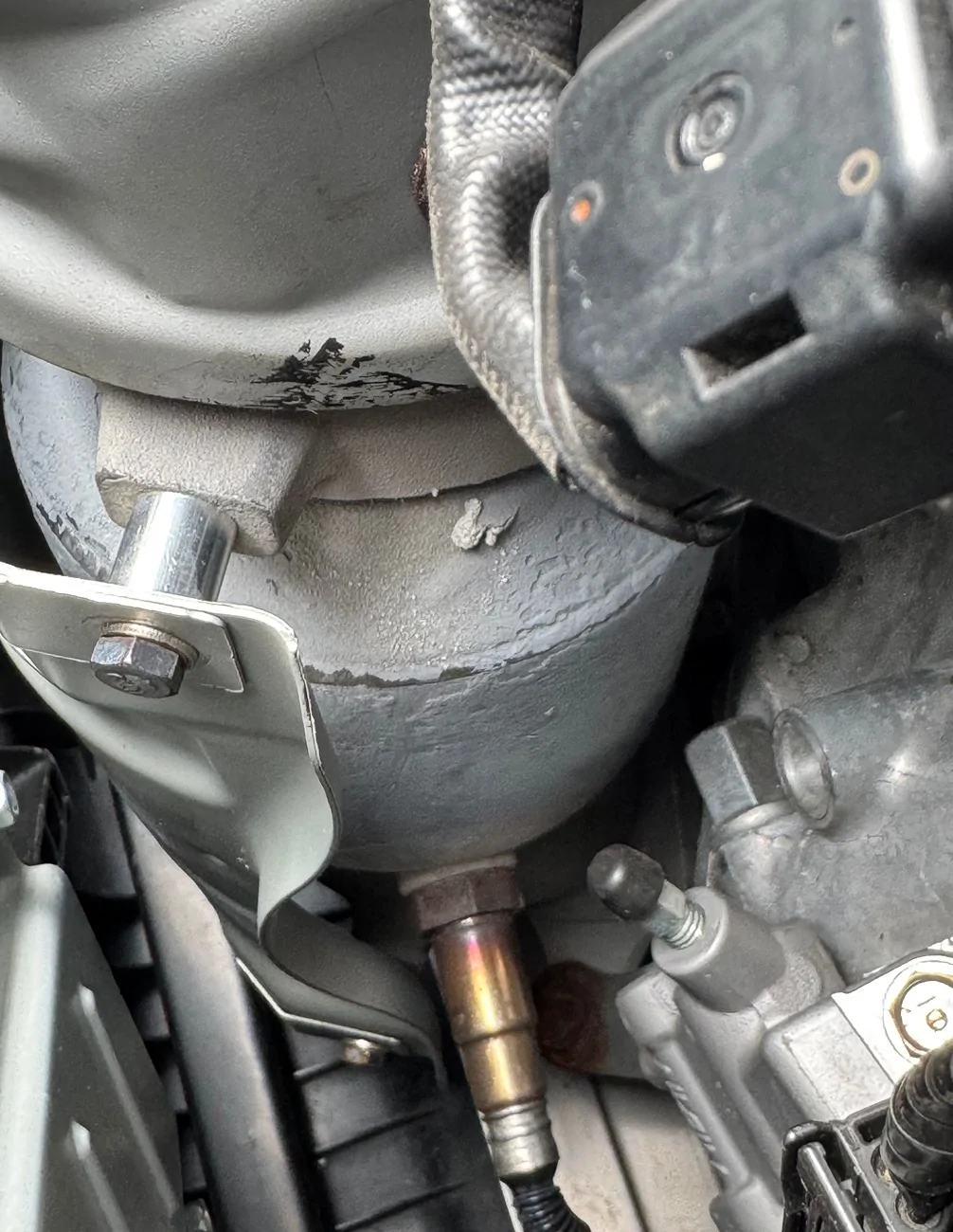
Why was Number three a bad one? Although it significantly reduced temps radiating from the downpipe onto other components under the hood, it also resulted in higher exhaust temperatures being contained within the downpipe itself. This caused the TSP downpipe base metal to expand greater than where the Swain Tech ceramic coating itself could expand. As a result, the Swain Tech ceramic coating started to crack and fracture in certain areas over time resulting in melted deposits of the coating becoming fused onto the internal SS mesh of the PTP hybrid downpipe blanket as can be seen in three areas in this PIC:
11th Gen Honda Civic Downpipe Hard Lagging, Soft Lagging, and Coating Discussion IMG_3205

This is just one issue with adding Number three.
 
Last edited:

tezzasaurusrex

Senior Member
First Name
Terence
Joined
Aug 16, 2022
Threads
5
Messages
380
Reaction score
963
Location
Australia
Vehicle(s)
Previous: K20Z1 EK Civic, Golf R Mk7.5, B8 RS4
Build Thread
Link
Yup, my experience has been positive having had several exhaust components hard lagged for both myself and my customers.

The main advantages are it drastically reduces heat deflection to adjacent components. So in the case of the FL5, it keeps the exhaust heat from travelling to the main coolant pipe behind the downpipe and up into the oil pan above the front pipe.

It is far more effective than heat wrap, and doesn't become a fire bomb in the event of an oil leak as it is not externally porous thus will not soak up oil or fuel.

My FL5 runs 500hp, on stock radiator, with no additional water or oil coolers. Any doubters can watch my videos to see the sort of temps my car can maintain throughout a full lap of a GP level circuit.

I have not experienced any accelerated rate of component failure due to heat retention within the exhaust system thus far. Been years of competition now.

11th Gen Honda Civic Downpipe Hard Lagging, Soft Lagging, and Coating Discussion 20251119_085807


11th Gen Honda Civic Downpipe Hard Lagging, Soft Lagging, and Coating Discussion 20260811_213251
 
Last edited:


OP
OP
blueroadster

blueroadster

Senior Member
Joined
Apr 19, 2024
Threads
38
Messages
758
Reaction score
1,068
Location
MD
Vehicle(s)
2024 Civic Type R, 2026 Passport TSE, 2026 Pilot BE, 1964 Impala SS
Why was Number three a bad one? Although it significantly reduced temps radiating from the downpipe onto other components under the hood, it also resulted in higher exhaust temperatures being contained within the downpipe itself. This caused the TSP downpipe base metal to expand greater than where the Swain Tech ceramic coating itself could expand. As a result, the Swain Tech ceramic coating started to crack and fracture in certain areas over time resulting in melted deposits of the coating becoming fused onto the internal SS mesh of the PTP hybrid downpipe blanket as can be seen in three areas in this PIC:
IMG_3205.webp

This is just one issue with adding Number three.
Here is a PIC of the TSP downpipe where some cracks and fractures in the coating appear around the corner edge of the catalytic converter:
11th Gen Honda Civic Downpipe Hard Lagging, Soft Lagging, and Coating Discussion IMG_3209

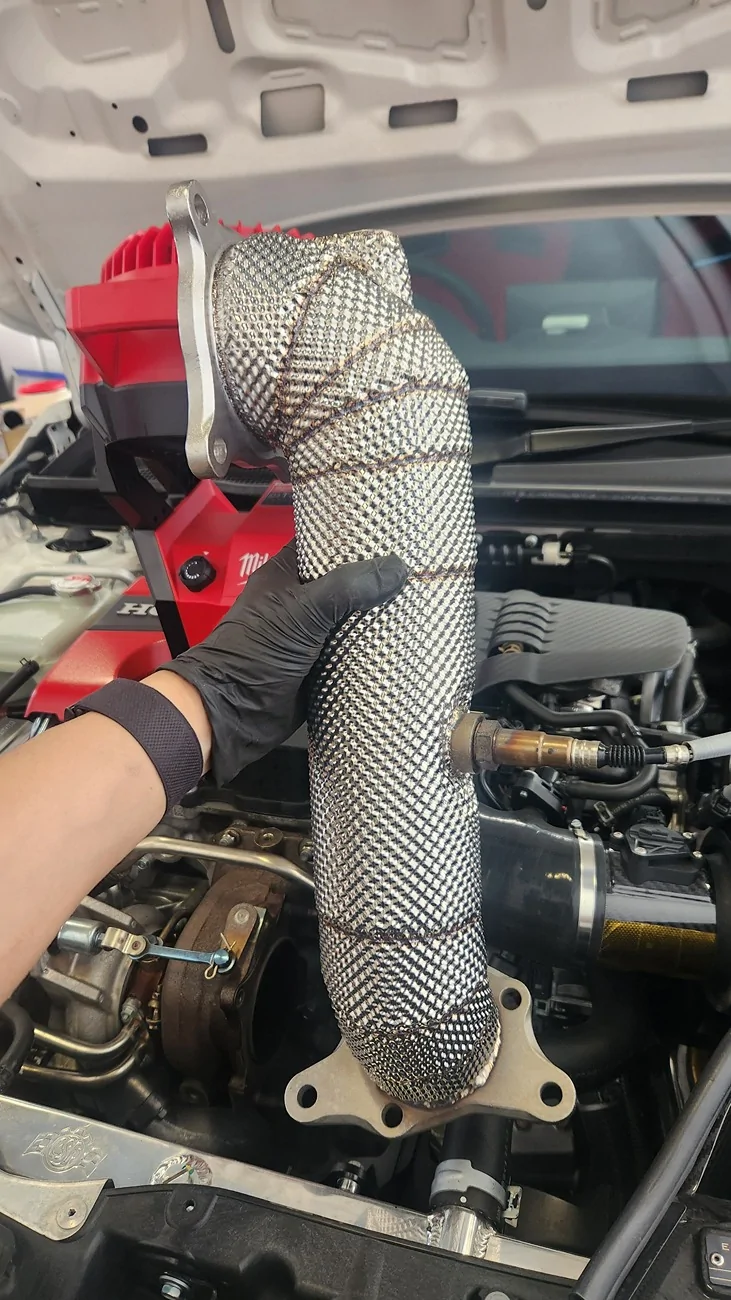
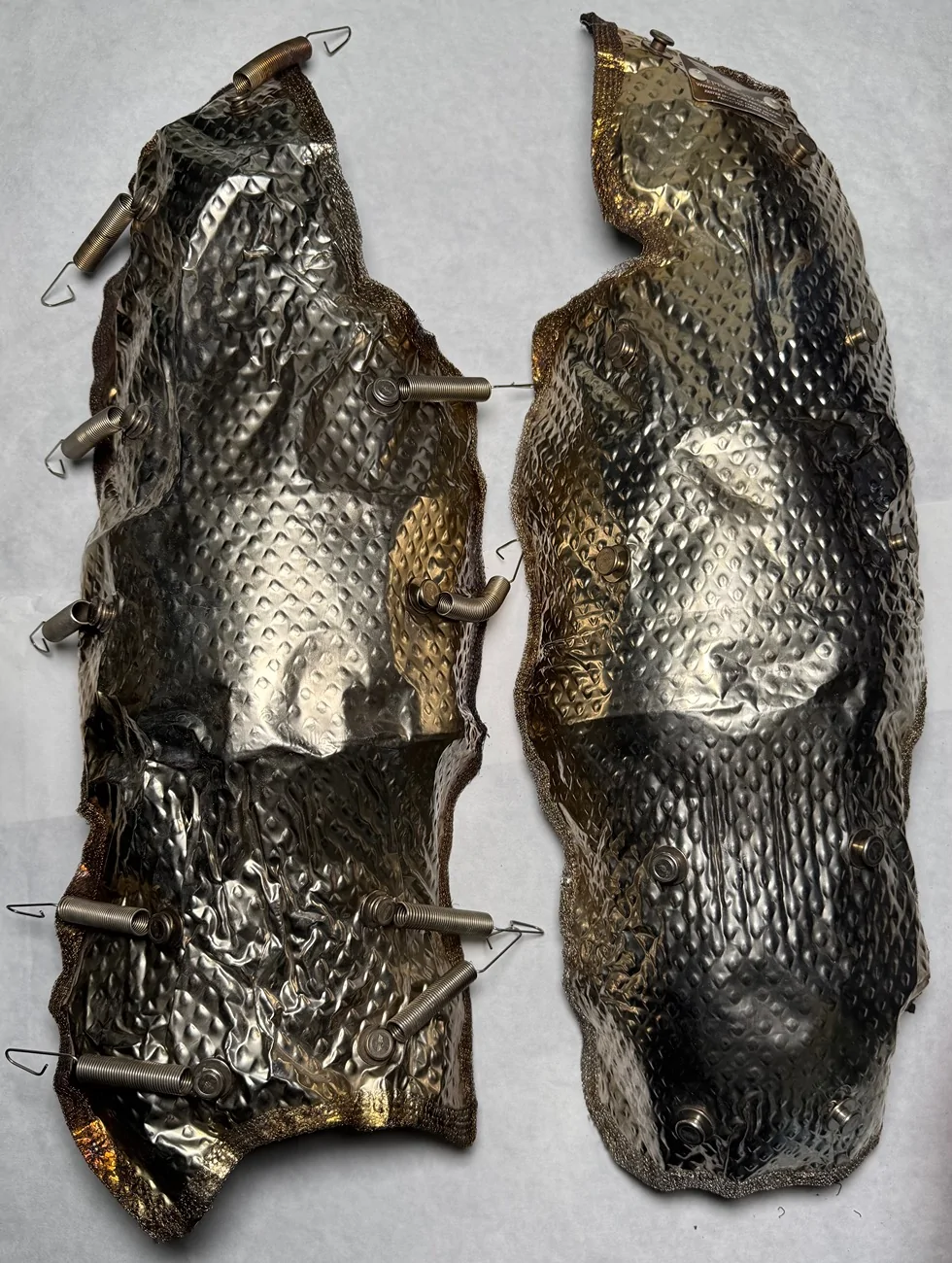
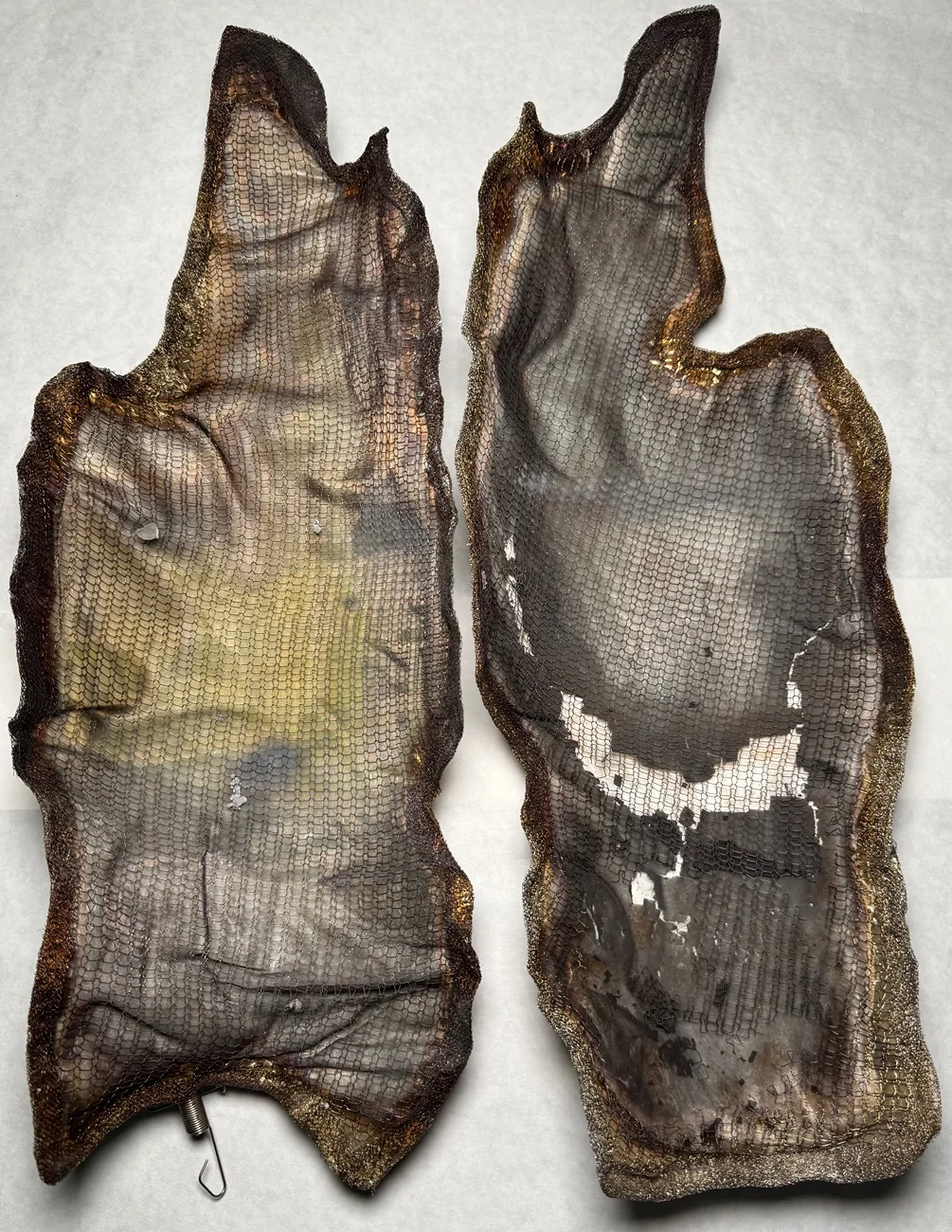
Here are two PICs of the PTP hybrid downpipe blanket (front section to the right…SS mesh and next layer was pinched and damaged during removal so the blanket is now toast):
11th Gen Honda Civic Downpipe Hard Lagging, Soft Lagging, and Coating Discussion IMG_3211
11th Gen Honda Civic Downpipe Hard Lagging, Soft Lagging, and Coating Discussion IMG_3210

So issue one for adding Number three is that if a ceramic coating was applied to the downpipe, the coating will fracture/ crack over time where deposits will get fused to the inner SS mesh on the blanket. On a positive note, most of the coating is still there to provide corrosion protection.

Issue two would be true for any soft lagged blanket in that the insulating material is porous and exposed to the elements where condensation can form within the insulating material. If the downpipe does not have a coating to provide corrosion protection, then at the next heat cycle, the raw surface will be exposed to burning off that condensation potentially leading to cracks forming over time.

From the above PICs, you can see the discoloration on the blanket. The outside PIC shows a tea colored discoloration around the edges where heat bled out. The inside PIC shows discoloration in the insulating layers. Interesting is that the discoloration on the front half of the shell is a fairly consistent gray whereas the back half of the shell shows different colors.

On a positive note, soft lagged blankets are removable where the downpipe and welds can be inspected.
 
OP
OP
blueroadster

blueroadster

Senior Member
Joined
Apr 19, 2024
Threads
38
Messages
758
Reaction score
1,068
Location
MD
Vehicle(s)
2024 Civic Type R, 2026 Passport TSE, 2026 Pilot BE, 1964 Impala SS
A lot of yapping on my end so here are my thoughts on downpipe options thus far:
  1. Coatings: I would recommend going this route with the intent of providing corrosion protection for the downpipe where the OEM heat shields are reused.
  2. Soft lagged: Adds a nice layer of beneficial thermal protection surrounding the downpipe when the OEM heat shields are not reused. Going this route, it would also be beneficial to have the downpipe coated to provide corrosion protection. Out of the options available, the PTP hybrid downpipe blanket appears to offer the best thermal protection but costs a lot more than a lava blanket. Soft lagged shields use an insulation layer that is exposed to the elements that results in other concerns. They are however removable to allow for later part inspection if needed.
  3. Hard lagged: Offers the best thermal protection without the concern of having the insulation layer exposed to the elements like soft lagging. The outer metallic shell is welded onto a raw downpipe surface where the insulation layer is encapsulated. They are not removable to allow for later part inspection if needed.
 
OP
OP
blueroadster

blueroadster

Senior Member
Joined
Apr 19, 2024
Threads
38
Messages
758
Reaction score
1,068
Location
MD
Vehicle(s)
2024 Civic Type R, 2026 Passport TSE, 2026 Pilot BE, 1964 Impala SS
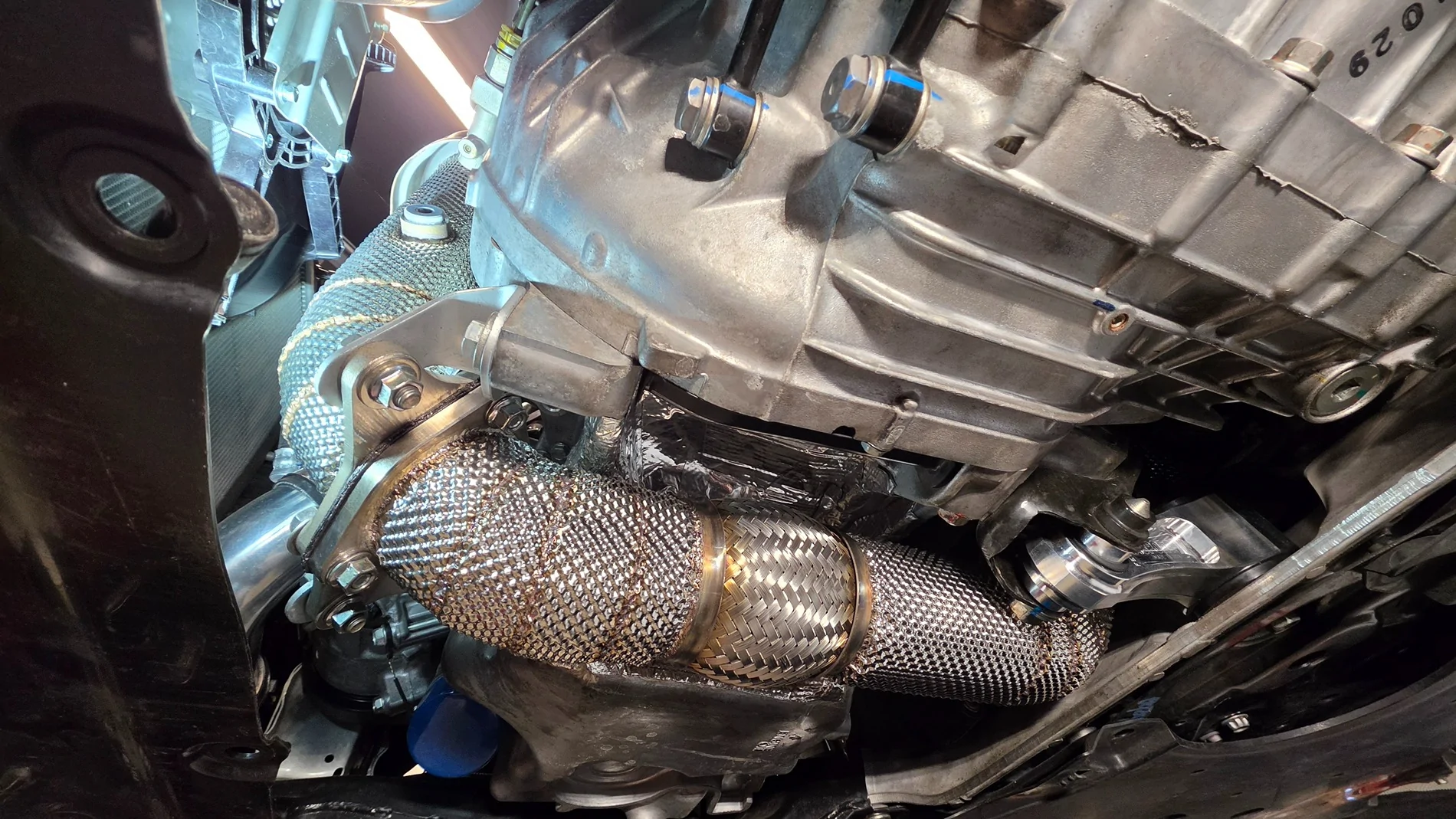
Yup, my experience has been positive having had several exhaust components hard lagged for both myself and my customers.

The main advantages are it drastically reduces heat deflection to adjacent components. So in the case of the FL5, it keeps the exhaust heat from travelling to the main coolant pipe behind the downpipe and up into the oil pan above the front pipe.

It is far more effective than heat wrap, and doesn't become a fire bomb in the event of an oil leak as it is not externally porous thus will not soak up oil or fuel.

My FL5 runs 500hp, on stock radiator, with no additional water or oil coolers. Any doubters can watch my videos to see the sort of temps my car can maintain throughout a full lap of a GP level circuit.

I have not experienced any accelerated rate of component failure due to heat retention within the exhaust system thus far. Been years of competition now.

20251119_085807.webp


20260811_213251.webp
Thanks for the detailed response. I am considering hard lagging on those exact same parts (i.e., downpipe and front pipe) for the best thermal protection. It is great to hear that the hard lagging you used has proven to be functional and durable without failure of the parts covered.
 
Last edited:
OP
OP
blueroadster

blueroadster

Senior Member
Joined
Apr 19, 2024
Threads
38
Messages
758
Reaction score
1,068
Location
MD
Vehicle(s)
2024 Civic Type R, 2026 Passport TSE, 2026 Pilot BE, 1964 Impala SS
@tezzasaurusrex addressed a lot of my concerns regarding hard lagging (i.e., functionality and durability).

My initial concerns with adding hard lagging:
  1. Manufacturer's warranty on the downpipe and welds would be voided: I presume since the part would have been physically altered while also being subjected to much higher operational temperatures that could lead to deformation, distortion, warping or issues with the welds. Since the downpipe is installed in a fixed position (i.e., connected between the turbine housing and lower support bracket), it would seem that this concern should be minimal.
  2. Galvanic corrosion of dissimilar metals: The SBX downpipe that I have is 304 SS so ideally, the hard lagged shell should be 321 SS or 347 SS. I see that an Inconel shell is optionally offered by some manufacturers so I would need to inquire about the benefit of its use.
  3. Mechanical engineering (specifically changes to thermodynamics): Heat = energy where retaining it in a system is a good thing. This is where pipe size, volume, velocity, and backpressure come into play. Ideally, you would want to retain heat as much as possible in the exhaust gasses to maintain velocity. As those gases cool, they expand causing an increase in backpressure which reduces velocity of the gasses being expelled from the turbine housing.
Number 3 is my general understanding without using technical mumbo jumbo (I believe the concept is correct). What I am curious about from a mechanical engineering (i.e., thermodynamics) perspective is:
  1. The general consensus that I have read from a few members on this forum is that there is not much of a performance increase offered by upgrading the OEM exhaust.
  2. The OEM downpipe outlet ID is ~2" and that ID is roughly maintained through the front pipe and out the exhaust.
  3. If one were to replace the OEM downpipe with an aftermarket one that has less backpressure and a 3" ID outlet, wouldn't the OEM front pipe and exhaust be a significant choke point since they have a ~2" ID? Also, as the exhaust gasses cool, they have no additional room to expand. In this case, I would think that use of OEM front pipe and downpipe would increase backpressure.
  4. Building on the above...If one were to add an aftermarket front pipe and exhaust that maintains the 3" ID outlet coming off of aftermarket downpipe, wouldn't this be more preferrable and offer a performance advantage? The ~2" choke point from the OEM downpipe and exhaust would have been eliminated resulting in much less backpressure in comparison.
  5. Building on the above...Adding hard lagging onto the aftermarket downpipe and front pipe would significantly reduce exhaust gas cooling until those gasses get pushed through the aftermarket exhaust itself. In this case, I would think that the volume (i.e., flow rate) of the exhaust gasses would need to be considered before concluding that the aftermarket 3" ID exhaust would also be a choke point.
Thanks for reading and time to switch into listening mode.
 
Last edited:

tezzasaurusrex

Senior Member
First Name
Terence
Joined
Aug 16, 2022
Threads
5
Messages
380
Reaction score
963
Location
Australia
Vehicle(s)
Previous: K20Z1 EK Civic, Golf R Mk7.5, B8 RS4
Build Thread
Link
@blueroadster

Choose a good downpipe to begin with, and you won't have warranty issues to be concerned about. Something with a cast turbo flange is in my opinion a must for serious circuit work. Catalyst quality being the second most important aspect. Catless takes away the risk/concern with the catalyst breaking down since it's not there.. but this choice depends on your application.

Galvanic corrosion between inconcel and stainless is low risk. The metals are similar in potential difference. Again, I've had no issues. If there were, after several years of service, you rip the hard lagging shell off, and redo the job. Nothing in life lasts forever, and you got your money's worth.

You raise a good point in regards to heat and exhaust flow. I think the hard lagged dp and fp would mean the heat and thus the internal pressure of exhaust gases in the piping will go up. So it stands to reason that a pipe ID that wasn't restrictive without the hard lagging may become so after hard lagging. Obviously it does depend on pipe design, elbow angles, and power output of your current set up. It is likely a non-issue under 500hp. Above that you probably would start to run systems above 3" ID anyway.

Something I forgot to mention with hard lagging, is that it will add another ~10mm to the OD of the pipe. So tight areas such as the front pipe elbow (depending on the particular front pipe) need to be modified to clear the sump. So you are best to install the system, check where it is tight, and make necessary modifications to ensure sufficient clearance before having it hard lagged.

As for ceramic coatings, I have never seen these coating systems last, and do anything meaningful other than look good for the first few months, and then crack, peel, and fail.
Sponsored


Top