
johnloov
Senior Member
- Thread starter
- #1
FL5 Track Cooling Project – Water Misting the Condenser/Radiator & Intercooler/ (Let's See If We Can Improve the Stock Cooling System)
I've been chasing one goal since buying my FL5:
Can a completely stock FL5 Type R reliably survive repeated summer HPDE sessions without requiring expensive aftermarket cooling upgrades?
Rather than immediately replacing the radiator, intercooler, oil cooler, etc., I wanted to first understand how Honda engineered the cooling system and see how far the stock package could be pushed using basic engineering and physics.
The mister is an amazing $59 dollar solution, that not only kept my temps in check on one of the hottest days, it also instantly made my A/C run Ice cold right after coming off track it used to take many minutes to get cold, and it was able to get my A/C blowing Ice cold in about 30 seconds. I also tried it on the way home on the highway. I would toggle it on and off, and I could feel the noticeable difference.


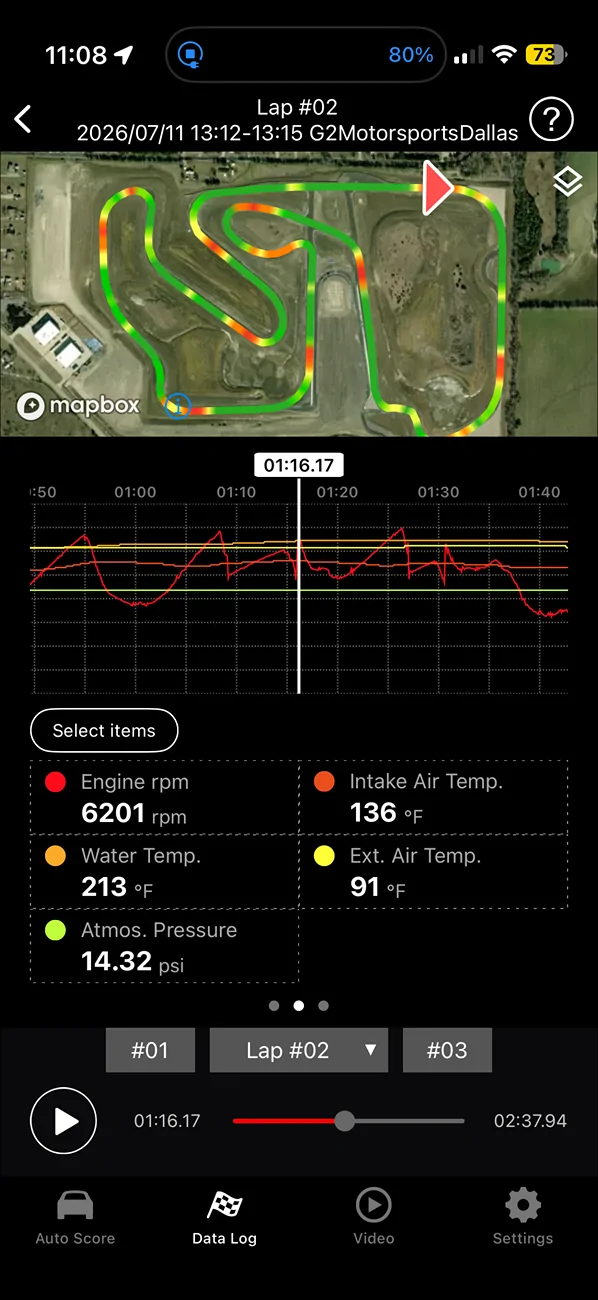
Without - Mister OFF - Water Temp 235F

With - Mister On - Water Temp 213F - Same exact hottest location on track
My Track Experience on Stock FL5 ( -3 Negative camber, Castrol SRF Fluid, Endless Endurance Circuit CC43 (N35S) brake pads )
No overheating
So far I've completed:
The car still has:
For oil I've consistently run:
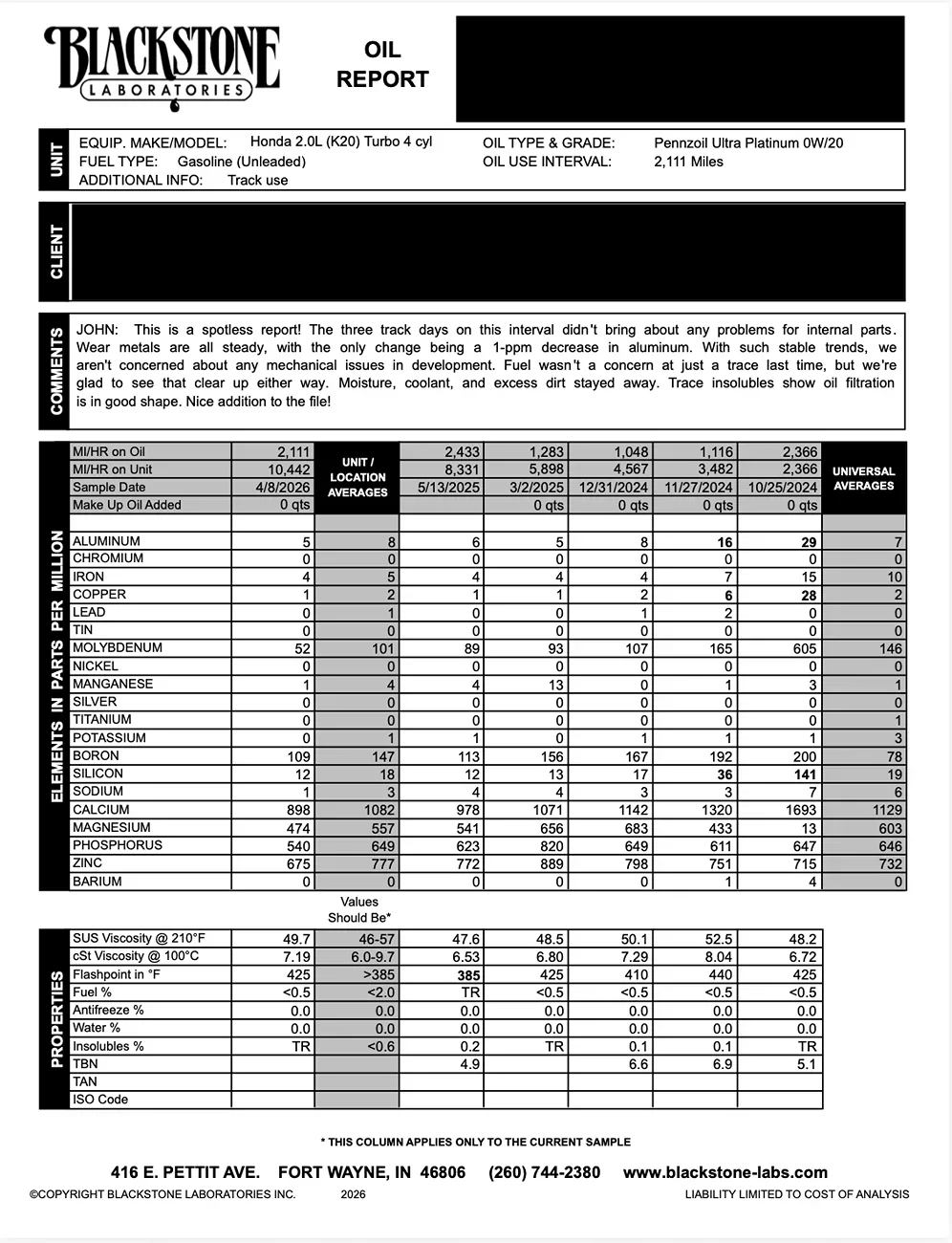
Instead of guessing, I've also been sending oil samples to Blackstone Laboratories after track use.
My latest report was after:
Blackstone's comments were:

Obviously this doesn't prove a cooling strategy works by itself, but it has given me confidence that the engine has been handling repeated track use well with my maintenance schedule.
My Heater Procedure
One thing I've done since my very first HPDE is run the heater.
For anyone unfamiliar:
The heater core is simply another heat exchanger.
My procedure has always been:
It's not comfortable, but it has become part of my normal track routine.
Using this method, I have never experienced limp mode or an overheating shutdown.
Understanding the FL5 Cooling Stack
One thing I don't think gets discussed enough is how Honda arranged the FL5 cooling system.
From front to back:
The radiator doesn't just control coolant temperature.
Because of Honda's coolant-to-oil heat exchanger and the transmission's thermal relationship with the engine cooling system, radiator performance also affects:
My Observation
I've noticed a trend while reading various FL5 build threads.
Many people install:
Some owners are still reporting coolant temperatures similar to—or even higher than—what I'm seeing with my completely stock cooling system while running the heater.
That got me thinking:
Instead of only increasing cooling capacity, can we improve the efficiency of the existing heat exchangers?
My Water Misting Experiment
That led me to evaporative cooling.
Using a removable battery-powered mister:
https://www.amazon.com/dp/B0GRTJ4CJW
I installed:
No permanent modifications.
First Track Test
Location:
G2 Motorsports Park
Date:
Saturday, July 11, 2026
Weather:
I completed repeated 30-minute sessions.
I never entered limp mode.
I never experienced an overheating shutdown.
The limiting factor for me became tire performance, not coolant temperature.
After the sessions, I also checked for water leakage and did not observe water dripping onto the racing surface. The water appeared to evaporate very quickly as it contacted the hot condenser/radiator stack.
One interesting observation:
While testing the system on the highway, turning the mister on made the A/C noticeably colder almost immediately, suggesting the condenser was definitely being cooled.
This Is NOT Me Claiming I've Solved FL5 Cooling
I don't think we're there yet.
This is simply an engineering experiment that I'd love to see more people help develop.
Questions I'd like to answer include:
If you're tracking an FL5, I'd love to see your:
Maybe we discover that a simple removable water mist system can make the stock cooling package more effective during extreme HPDE conditions.
Either way, I'd rather answer the question with data than assumptions.
Let's see what we can learn together.
Anyone else tried a water misting solution to cool their cars?
I've been chasing one goal since buying my FL5:
Can a completely stock FL5 Type R reliably survive repeated summer HPDE sessions without requiring expensive aftermarket cooling upgrades?
Rather than immediately replacing the radiator, intercooler, oil cooler, etc., I wanted to first understand how Honda engineered the cooling system and see how far the stock package could be pushed using basic engineering and physics.
The mister is an amazing $59 dollar solution, that not only kept my temps in check on one of the hottest days, it also instantly made my A/C run Ice cold right after coming off track it used to take many minutes to get cold, and it was able to get my A/C blowing Ice cold in about 30 seconds. I also tried it on the way home on the highway. I would toggle it on and off, and I could feel the noticeable difference.
Without - Mister OFF - Water Temp 235F
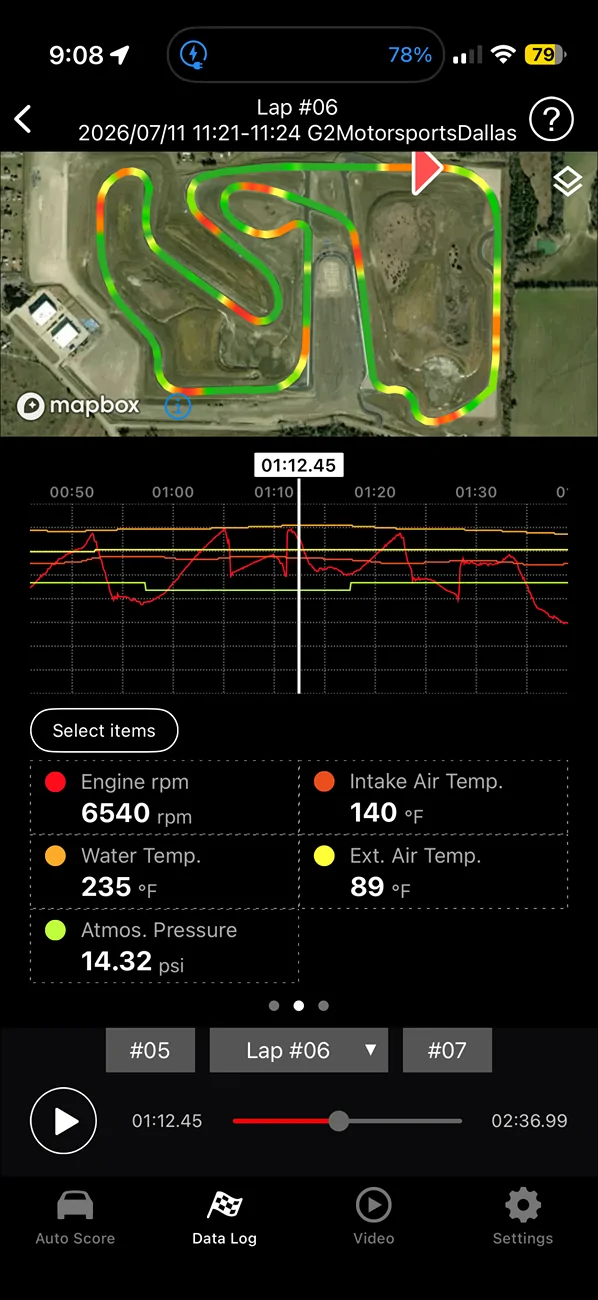
With - Mister On - Water Temp 213F - Same exact hottest location on track
My Track Experience on Stock FL5 ( -3 Negative camber, Castrol SRF Fluid, Endless Endurance Circuit CC43 (N35S) brake pads )
No overheating
So far I've completed:
- 20+ HPDE days at WeatherTech Raceway Laguna Seca
- 6 HPDE days at Circuit of the Americas (COTA)
- 2 HPDE days at G2 Motorsports Park (Dallas)
The car still has:
- OEM radiator
- OEM intercooler
- OEM condenser
- OEM coolant-to-oil heat exchanger
- OEM transmission cooling
For oil I've consistently run:
- Honda Ultimate OW-20 & Pennzoil Ultra Platinum 0W-20 ( circulates faster, lower engine temps )
- Oil changes every 2–4 track days (~2,000 miles)
Instead of guessing, I've also been sending oil samples to Blackstone Laboratories after track use.
My latest report was after:
- 2,111 miles
- 3 track days
Blackstone's comments were:
Wear metals remained very low, and there was no evidence of coolant contamination or abnormal engine wear during this interval."This is a spotless report... Wear metals are all steady... Fuel wasn't a concern... Moisture, coolant, and excess dirt stayed away... Nice addition to the file."
Obviously this doesn't prove a cooling strategy works by itself, but it has given me confidence that the engine has been handling repeated track use well with my maintenance schedule.
My Heater Procedure
One thing I've done since my very first HPDE is run the heater.
For anyone unfamiliar:
The heater core is simply another heat exchanger.
My procedure has always been:
- A/C OFF
- Temperature set to maximum heat
- Driver vent closed
- Center vents pointed toward the passenger window
- Passenger vent pointed toward the passenger window
- Blower fan OFF
- Recirculate ON
It's not comfortable, but it has become part of my normal track routine.
Using this method, I have never experienced limp mode or an overheating shutdown.
Understanding the FL5 Cooling Stack
One thing I don't think gets discussed enough is how Honda arranged the FL5 cooling system.
From front to back:
- Intercooler
- A/C condenser
- Engine radiator
The radiator doesn't just control coolant temperature.
Because of Honda's coolant-to-oil heat exchanger and the transmission's thermal relationship with the engine cooling system, radiator performance also affects:
- Engine coolant
- Engine oil temperature
- Transmission temperature
My Observation
I've noticed a trend while reading various FL5 build threads.
Many people install:
- Larger radiators
- Auxiliary oil coolers
- Bigger intercoolers
Some owners are still reporting coolant temperatures similar to—or even higher than—what I'm seeing with my completely stock cooling system while running the heater.
That got me thinking:
Instead of only increasing cooling capacity, can we improve the efficiency of the existing heat exchangers?
My Water Misting Experiment
That led me to evaporative cooling.
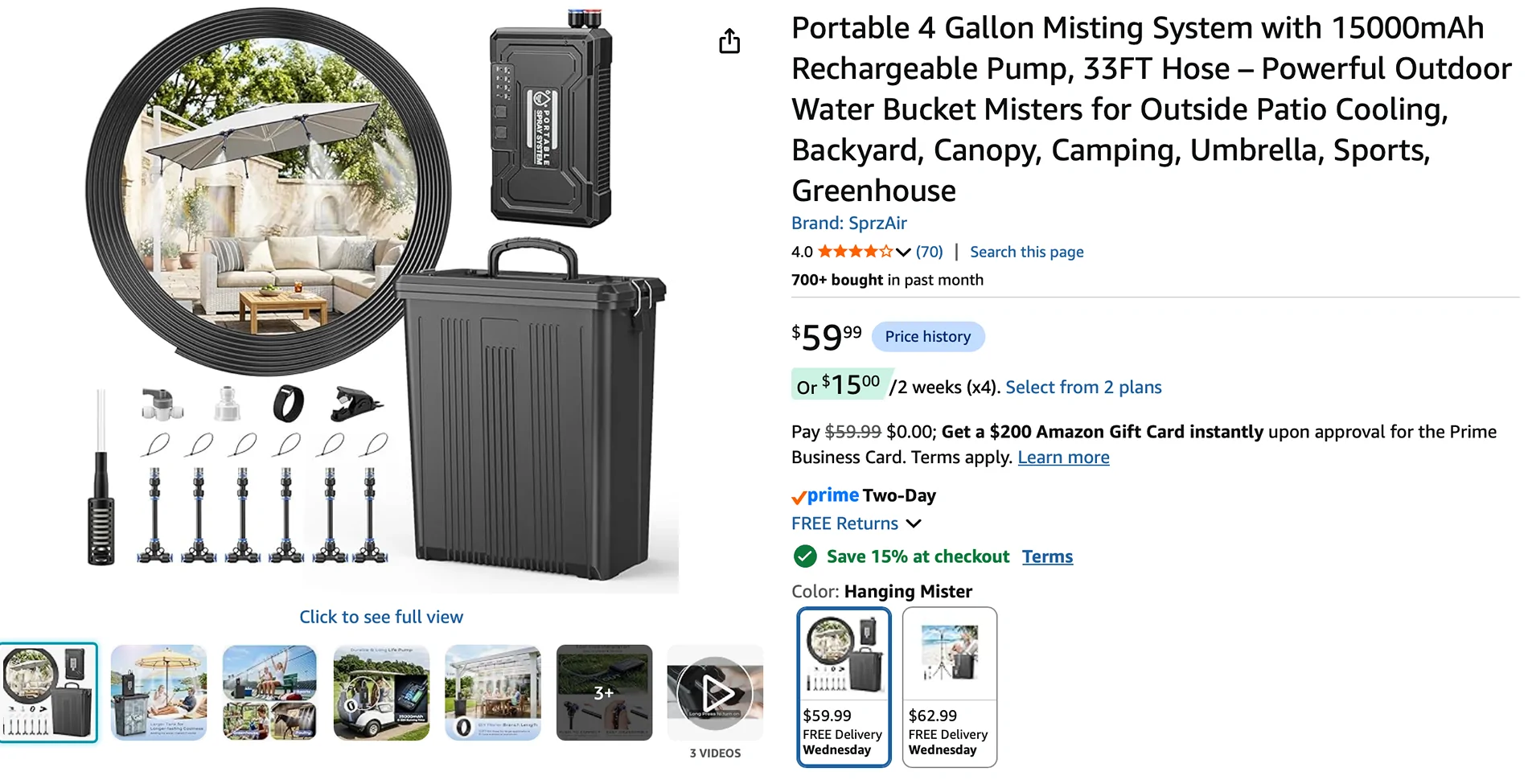
Using a removable battery-powered mister:
https://www.amazon.com/dp/B0GRTJ4CJW
I installed:
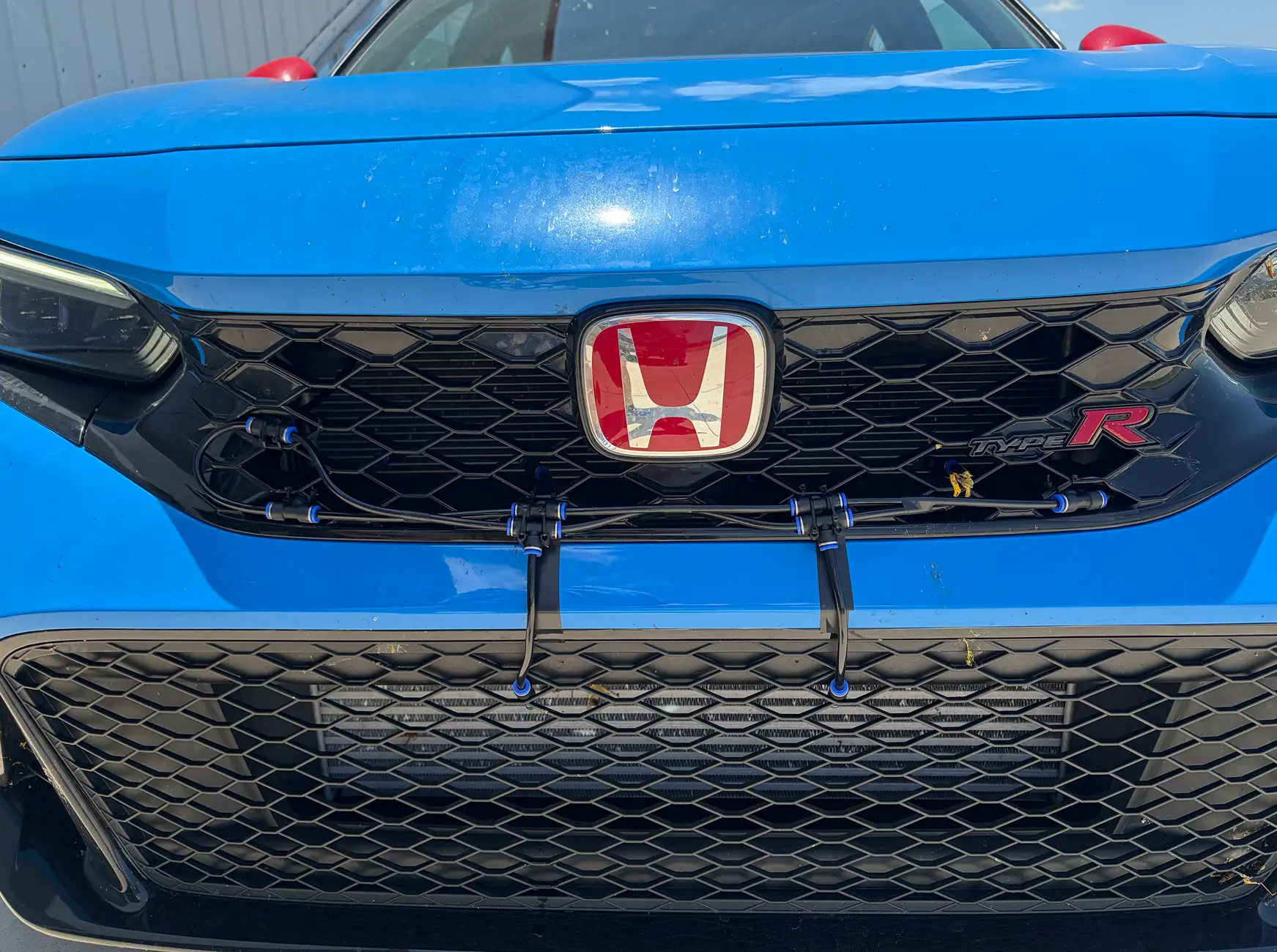
- 4 fine-mist nozzles aimed at the condenser/radiator stack
- 2 fine-mist nozzles aimed at the intercooler
No permanent modifications.
First Track Test
Location:
G2 Motorsports Park
Date:
Saturday, July 11, 2026
Weather:
- Ambient approximately 99°F
- Heat index approximately 103°F
- Heater ON
- A/C OFF
- Water mister ON
I completed repeated 30-minute sessions.
I never entered limp mode.
I never experienced an overheating shutdown.
The limiting factor for me became tire performance, not coolant temperature.
After the sessions, I also checked for water leakage and did not observe water dripping onto the racing surface. The water appeared to evaporate very quickly as it contacted the hot condenser/radiator stack.
One interesting observation:
While testing the system on the highway, turning the mister on made the A/C noticeably colder almost immediately, suggesting the condenser was definitely being cooled.
This Is NOT Me Claiming I've Solved FL5 Cooling
I don't think we're there yet.
This is simply an engineering experiment that I'd love to see more people help develop.
Questions I'd like to answer include:
- Is a finer mist better than larger droplets?
- Where is the best locations to spray
- Is there a way to spray between the condenser and radiator?
- Is condenser-only spraying better than condenser plus intercooler?
- What nozzle pressure is ideal?
- What flow rate is ideal?
- Does a higher-pressure pump improve evaporative cooling?
- How much coolant temperature reduction is actually achievable?
- How much can charge-air temperatures be reduced?
- Can we mist the brake as some race cars do to cool brakes including brake ducting.
If you're tracking an FL5, I'd love to see your:
- Coolant temperatures
- Oil temperatures
- Intake air temperatures
- Ambient temperatures
- Cooling modifications
- Data logs
- Photos
- Ideas
Maybe we discover that a simple removable water mist system can make the stock cooling package more effective during extreme HPDE conditions.
Either way, I'd rather answer the question with data than assumptions.
Let's see what we can learn together.
Anyone else tried a water misting solution to cool their cars?
Last edited: