
Sponsored

Correcting the record on manual transmission fluid disinfo

Nothing

Senior Member
Joined
Dec 15, 2023
Threads
2
Messages
220
Reaction score
127
Location
California
Vehicle(s)
2023 CW FL5 #5044
You claim to speak for the average owner?

I have not had grinding, I'm not adding power, and I'm never going to track this car.

Swapping the fluid for Red Line MTL at ~4000 miles (after break in) made a VERY positive difference, on the level of the difference that the Acuity shifter made. The feel of the synchros through the shifter changed quite drastically. The OEM fluid felt inconsistent, irregular, and the shift effort was higher than it should be. Red Line MTL immediately gave me consistency, smoothness, and lessened shift effort.

The average owner of a CTR is an enthusiast almost by definition, not the plebe you imagine. Certainly if they've found this thread.

If you don't want to modify your car, don't modify your car. Instead you choose to tell other people to not modify their car. Why? Really... why?
At 4k miles on factory MTF, do you expect the feel to be representative of new OEM fluid? Such that OEM wouldn't also feel "smooth".

90% of owners could stick with OEM, but also 90% of owners could stay stock. Neither of those are likely because racecar. OEM shifter is pretty good, Acuity is better, just comes down to where on the spending priority it falls for each owner.

Education is education, but like brake pad threads and the entirety of BITOG, user feedback helps us make informed choices. Certainly we don't all want to be running the same fluids just because.
Sponsored

 

PointByPatrol

Senior Member
First Name
Ben
Joined
Jul 28, 2023
Threads
44
Messages
2,014
Reaction score
3,187
Location
NC
Vehicle(s)
2024 Civic Type R
Build Thread
Link
I have come across so much uninformed nonsense on this topic. It's actually worse than the uninformed nonsense regarding engine oil, because while using "MEGA-BRAND X" instead of "brand Zā„¢ " likely will do no harm assuming they're both API engine oils, gear oil is a much broader spectrum with much looser requirements and far more varied applications. Only knowing a small part of the picture when it comes to gear oil can easily result in going wrong.

Starting off with the science

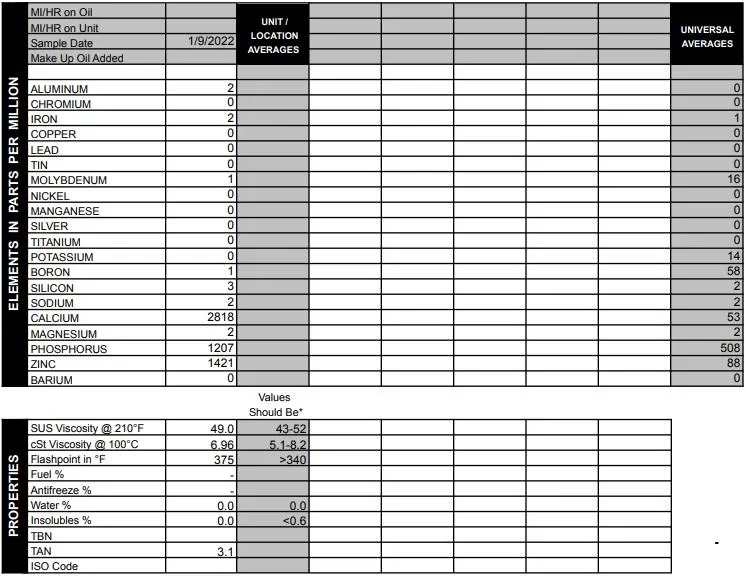
The Honda MTF recommended by the US owner's manual is, quite literally, an engine oil with different additives. There's actually not a lot to it. Labs like Blackstone use ICP spectrometry to determine the elemental composition of used or new oil samples. Here's a "Virgin Oil Analysis" or VOA showing what's in the US-made "Honda Genuine" MTF:

1776875128449-0b.webp


Credit to himemsys at BITOG for that.

The main additives here show up in the form of calcium, phosphorus, and zinc.

VOA Interpretation

Here's what subject matter expert MolaKule (someone who works in this industry and has formulated lubricants) has to say about the above lab result:


I started this section off by saying that Honda MTF is literally an engine oil with different additives, so what is different?

Calcium

The calcium may be evidence of a dispersant/detergent such as calcium sulfonate (the usual case in motor oil) but as Mola Kule says, the use case in gear oil would be as a friction modifier. Note that in an engine oil, calcium would have to be balanced out with magnesium to prevent LSPI, but we see none of that here. And that makes sense because this oil isn't intended to be exposed to combustion. Virtually all gear oils intended for use with synchromesh transmissions have some sort of friction modifier additive, which is there to help the synchronizers grab. If this were a motor oil, the calcium would be off the chart high, triple what is in modern engine oil. There's absolutely no need for that much detergent/dispersant in an environment that sees no soot or other combustion byproduct contamination. And engine oils aren't reliant on friction modifiers and extreme pressure additives in the same way synchromesh transmissions are. So by process of elimination, we can understand what's going on.

It's also important to understand that one additive can indeed do multiple things. More from MolaKule:


Zinc and Phosphorus

Regarding the zinc and phosphorus in Honda MTF, they could be mistaken for an older engine oil formulations with more ZDDP (Zinc Dialkyl Dithiophosphate) but is perhaps double what would be in most modern oils. ZDDP is an anti-wear (AW) and extreme pressure (EP) additive. It's important to note that for the purposes of use in a synchromesh transmission, ZDDP is activated with high heat and pressure, and it's attracted to iron. It does not attack brass and bronze found in synchronizers.

As for what Honda MTF lacks, in virgin motor oils we would be accustomed to seeing higher levels of molybdenum, boron, and silicon, on top of the aforementioned magnesium.

Molybdenum

Molybdenum disulfide (commonly referred to as just "moly") would fight the friction modifiers in this oil. It is used in GL-5 gear oils where there is sliding contact, but it isn't needed with transmission gears (typically calling for GL-4 gear oil) that have more of a rolling contact. In a synchromesh transmission, if the gear oil is too slippery, your synchronizers don't have enough grip to work and this will cause issues. Moly is also hard to flush out, because it sticks to the metal and gets into the pores. The 1ppm of moly you see in the Honda Genuine MTF VOA isn't enough to create an issue.

More on moly here.

Boron

Hexagonal boron nitride, boric acid, potassium triborate, sodium borate, borate esters, phosphorylated borate, and tri-potassium borate are another class of additives you might see in a GL-5 gear oil in the 100-500ppm range, and it's all but absent here at only 1ppm. Why? Boron additives act very similarly to moly additives in that they stick to the metal surface. It's for this same reason that they're bad for the synchronizers: friction is needed for synchronizer function, and if they're coated in a nano-layer of too much EP/AW additive, they stop working.

Some MTL formulations may use boron, but they're also likely using something to offset it. I have noticed that boron is present in many fluids designed for use in a transaxle with a hypoid gear - such as a Subaru manual transmission. Examples of this include Subaru's own 75W-90 and Motul Gear 300 75W-90. Because of the hypoid differential and transmission sharing one fluid, compromises in the additive package must be made. Our transmissions don't have hypoid gears and as such, lack the need for high levels of EP additive.

It's important to note that boron additives are typically a secondary EP/AW additive in that they tend to work best in colder temperatures, whereas the primary EP/AW additive (such as Sulphur-Phosphorus or ZDDP) will tend to work best in hotter temperatures.

What's impossible to discern

Because we are limited to understanding the elemental breakdown rather than the chemical properties (as just one example of many, calcium carbonate and calcium sulphonate will be indistinguishable on this ICP spectrometry test) and because we also aren't examining the physical nature of the additives (calcium sulphonate is a particle, and the size will vary) we can't know for certain what the absolute nature of any of these proprietary fluids is.

This is why I have referenced posts by MolaKule. His decades of experience with the chemistry and application requirements is what allows him to make those inferences.

The reality is that Honda is a car company, not an oil company. They pay third parties to blend and bottle their house-brand fluids, and those third parties are all using similar sets of base oils and additives, in a proprietary blend. They aren't even the same third parties across the globe - Honda MTF is made in at least three countries depending on the market: Japan, USA, and the UK.

What we can know - UOA

Worried your "Honda Genuine MTF" isn't the greatest? Worried your SuperLube Extreme XL++ is eating your synchros?

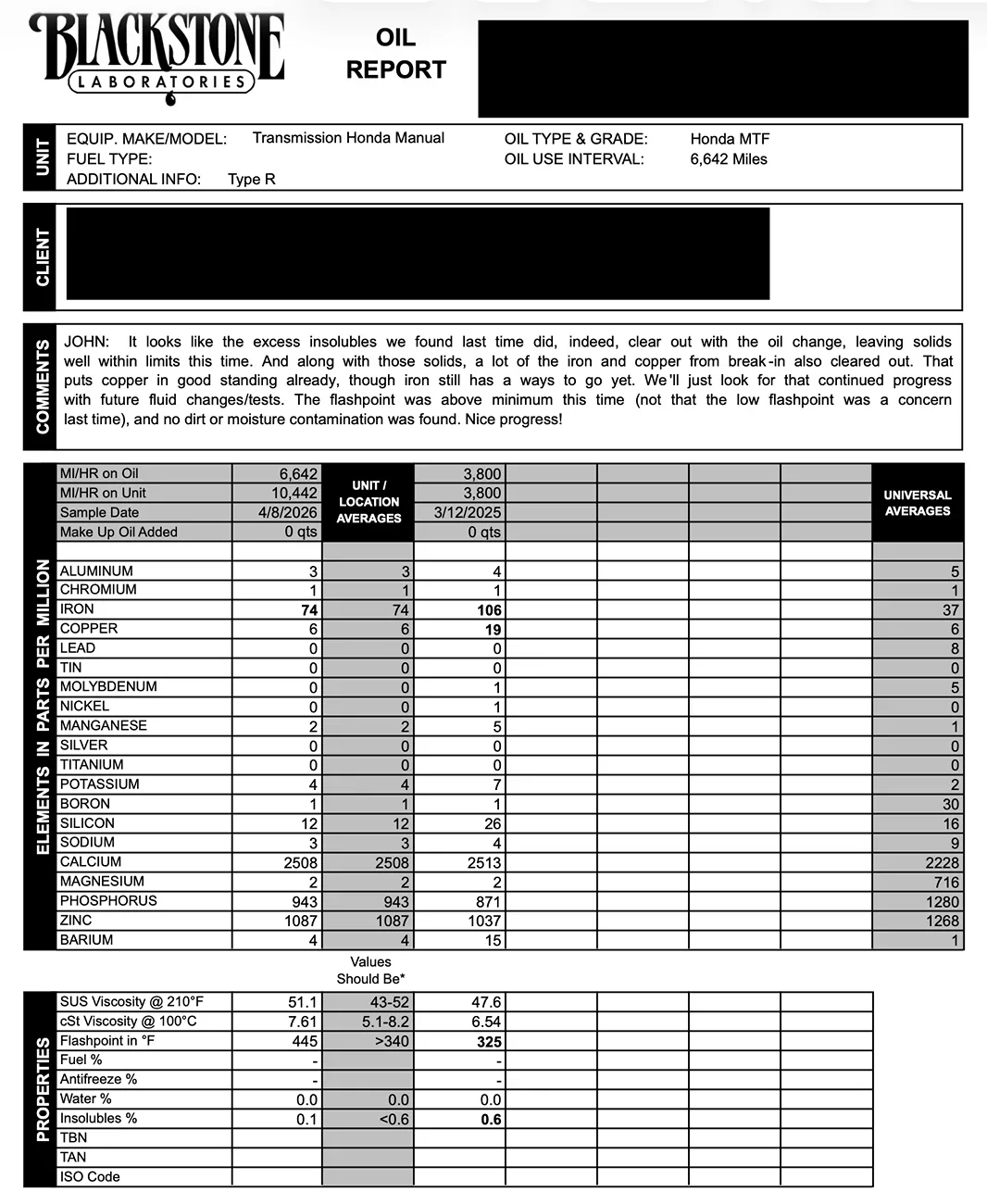
For a few smackeroos, send your used trans fluid off to a lab such as Blackstone or SPEEDiagnostix and find out what wear metals are floating around in there. They will send you a UOA or Used Oil Analysis looking something like this:

1776891318000-dw.webp


Credit to @johnloov for that UOA.

What to look for in third party fluids

This could be an entire book, so I'll try to keep it concise:
  • API Category - GL-4 vs GL-5
    • GL-4 gear oils have roughly half the EP additives as GL-5 gear oils. The reason for this is application: GL-5 gear oils are broadly intended for use with hypoid differentials, such as those found in vehicles with longitudinal engine layouts and rear differentials on AWD applications. Hypoid differentials have very specific EP additive requirements for longevity, and the primary additive used is sulphur-phosphorus (S-P). This is bad for manual transmissions in two ways: one, it's too slippery for the synchronizers to work properly. Two, the S-P additive chemically attacks yellow metals like brass and bronze found in synchronizers. We don't have a hypoid differential in our cars, so there is no reason to ever use a GL-5 gear oil.
    • Some oils will claim both GL-4 and GL-5 compatibility. I believe these are formulated for transaxles that do have a hypoid gear, and they are best avoided due to the compromised nature of the additives. There need to be additional additives present to offset/passivate the higher levels of S-P additive.
    • In short, always use a GL-4 gear oil.
  • Oil viscosity
    • Honda MTF is quite thin, somewhere between a 70W-75 and a straight 70W.
    • If that sounds thick, it's not. It's closer to 0W-20 motor oil, however gear oils and motor oils use different scales in order to avoid customer confusion.
    • Using a gear oil close to the Honda MTF spec is likely a good idea if you live in an area that gets extremely cold winters.
    • Going up in SAE oil weight may be a good idea if you never deal with extreme cold, or you track your car regularly.
    • I cover various fluids organized by oil weight in this thread.
  • Additives
    • Third party oil blends, just like the first party Honda blend, are proprietary. You aren't going to be able to easily find out whether a given blend is "right" for your application by looking at some ingredient label, simply because that information is tightly controlled.
    • What you can do is put some trust in a couple of things:
      • Manufacturer recommendations: Red Line for instance makes quite a few GL-4 gear oils, but the one they recommend in lieu of Honda MTF is Red Line MTL (75W-80 viscosity.) None of their other GL-4 gear oils are directly recommended for the Civic Type R.
      • Manufacturer recommendations, part 2: If the oil manufacturer is advertising the gear oil for use in transmissions that are very unlike your transmission, then it's likely not the most suitable option out there. There's nothing to win by being a hipster and running gear oil intended for a dual-clutch transmission, simply because it says its for both DCT and manual transmissions. While DCT applications have a lot in common with our cars, they also have different needs such as running wet clutches. This is just one example, another is the different requirements of hypoid differentials that I covered above.
      • End user experience:
        • If you can find other people posting UOA, great! That's indicative of how the oil's anti-wear additives perform.
        • If you can find other people posting about shift feel, also great! That's indicative of how the oil's friction modifier additives perform.
        • If you can find other people posting about cold weather performance, extra great! That's indicative of how the oil's viscosity and VII additives perform.
Fighting examples of disinfo

I'm going to add to this thread when I run across disinfo (here and elsewhere) and include a rebuttal.
I've just got to know what you do for a living??
 

Nothing

Senior Member
Joined
Dec 15, 2023
Threads
2
Messages
220
Reaction score
127
Location
California
Vehicle(s)
2023 CW FL5 #5044
My wild guess. Some sort of systems test engineer or chemicals engineer background. Appreciation for nuances in formulation and ideal and application factors. Better report style than most mechanical engineers, and cites sources. Thrives in BITOG discussions. šŸ˜†
 

PointByPatrol

Senior Member
First Name
Ben
Joined
Jul 28, 2023
Threads
44
Messages
2,014
Reaction score
3,187
Location
NC
Vehicle(s)
2024 Civic Type R
Build Thread
Link
My wild guess. Some sort of systems test engineer or chemicals engineer background. Appreciation for nuances in formulation and ideal and application factors. Better report style than most mechanical engineers, and cites sources. Thrives in BITOG discussions. šŸ˜†
He is in a job where ā€œsweating the detailsā€ not only matters, but is an obsession. I wish I had that drive, but I am well fit for what I do, but occasionally I appreciate this sort of detail. Though I don’t have the attention span to read through all of it.
 

johnloov

Senior Member
First Name
John
Joined
Jul 9, 2024
Threads
3
Messages
382
Reaction score
389
Location
USA
Vehicle(s)
FL5
This is why it’s critical to change your motor oil and transmission oil frequently in breaking in both. Removing contaminants until you see a stabilization in Parts per million. Looks like the engine is stabilized, but the transmission needs a few more flushes. The transmission fluid on my Type R transmission after two changes is still off the charts — consistent with lake speed juniors analysis on his Toyota, which means I need to flush out all contaminants from the transmission to maximize longevity as all break in metals float in the fluid and caused the most damage with the engine and transmission. It also explains why my transmission feels much better every time I change the fluid and there’s a question as to is peopleā€˜s perception to changing to a different brand the difference or the fact that they’re flushing out the transmission fluid no matter, you have to clean those wear metals out. Data data data is the only truth we can empirically measure. This is exactly why in my first startup we analyzed all flight data recorder data, and built systems for the major airlines, and we adjusted maintenance schedules based on data. This transmission fluid data proves you need to flush it out much more than I expected. I should’ve been changing it with every engine oil change (2-3k miles) until I saw ppm stabilize. It’ll be interesting to see other people’s Gear oil analysis, and parts per million and see if it performs better than the OEM fluid.
 
Last edited:


OP
OP

Spart

Senior Member
Joined
May 31, 2025
Threads
5
Messages
243
Reaction score
338
Location
Midwest
Vehicle(s)
2025 Integra Type S
It also explains why my transmission feels much better every time I change the fluid and there’s a question as to is peopleā€˜s perception to changing to a different brand the difference or the fact that they’re flushing out the transmission fluid no matter, you have to clean those wear metals out.
Perhaps, but I've heard more than once (including from folks with FK8's) that changing the factory fluid for Honda OEM made things feel worse. And heard the opposite, to be fair.

There are also quite a few folks that changed a few different fluids out back-to-back, not really giving the fluid an opportunity to get contaminated again. That's probably the most surefire way to discover differences.

Data data data is the only truth we can empirically measure.
Hard to quantify the shift feel and cold weather performance, unfortunately. UOA is only one piece of the picture.
 

johnloov

Senior Member
First Name
John
Joined
Jul 9, 2024
Threads
3
Messages
382
Reaction score
389
Location
USA
Vehicle(s)
FL5
I agree - I have no reference or baseline for other oils and viscosities - to understand feel. I am initially sticking with OEM until I get a good stable containment level baseline - then I hope to take the communities advice on the next best trans oil and then see what the blackstone results show and also only then will I be able to comment on the feel vs the stock oil once all break in contaminants are flushed - Looking forward.
Sponsored


Top