Sponsored

Correcting the record on manual transmission fluid disinfo

Spart

Senior Member
Joined
May 31, 2025
Threads
5
Messages
243
Reaction score
338
Location
Midwest
Vehicle(s)
2025 Integra Type S
I have come across so much uninformed nonsense on this topic. It's actually worse than the uninformed nonsense regarding engine oil, because while using "MEGA-BRAND X" instead of "brand Z™ " likely will do no harm assuming they're both API engine oils, gear oil is a much broader spectrum with much looser requirements and far more varied applications. Only knowing a small part of the picture when it comes to gear oil can easily result in going wrong.

Starting off with the science

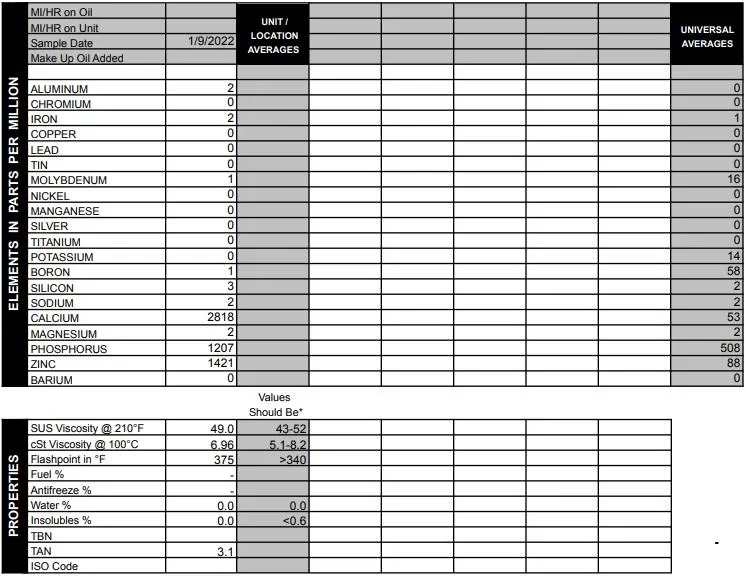
The Honda MTF recommended by the US owner's manual is, quite literally, an engine oil with different additives. There's actually not a lot to it. Labs like Blackstone use ICP spectrometry to determine the elemental composition of used or new oil samples. Here's a "Virgin Oil Analysis" or VOA showing what's in the US-made "Honda Genuine" MTF:

11th Gen Honda Civic Correcting the record on manual transmission fluid disinfo 1776875128449-0


Credit to himemsys at BITOG for that.

The main additives here show up in the form of calcium, phosphorus, and zinc.

VOA Interpretation

Here's what subject matter expert MolaKule (someone who works in this industry and has formulated lubricants) has to say about the above lab result:

MolaKule said:
Thanks for the New Oil analysis.

Calcium is your main friction modifier, and the ZDDP is your main anti-wear chemistry AW with its phosphorus and zinc elements.

Sodium is an anti-rust component.
I started this section off by saying that Honda MTF is literally an engine oil with different additives, so what is different?

Calcium

The calcium may be evidence of a dispersant/detergent such as calcium sulfonate (the usual case in motor oil) but as Mola Kule says, the use case in gear oil would be as a friction modifier. Note that in an engine oil, calcium would have to be balanced out with magnesium to prevent LSPI, but we see none of that here. And that makes sense because this oil isn't intended to be exposed to combustion. Virtually all gear oils intended for use with synchromesh transmissions have some sort of friction modifier additive, which is there to help the synchronizers grab. If this were a motor oil, the calcium would be off the chart high, triple what is in modern engine oil. There's absolutely no need for that much detergent/dispersant in an environment that sees no soot or other combustion byproduct contamination. And engine oils aren't reliant on friction modifiers and extreme pressure additives in the same way synchromesh transmissions are. So by process of elimination, we can understand what's going on.

It's also important to understand that one additive can indeed do multiple things. More from MolaKule:

MolaKule said:
Magnesium and Calcium sulphonates or carbonates -- In an MTF this is the primary Friction Modifier, not a detergent. Specialized forms of Magnesium, Sodium and Calcium carbonates and sulfonates have been discussed as Friction Modifiers in MTF's and ATF's in various posts. Magnesium, Sodium and Calcium sulfonates and succinimides are used as detergents in engine oils. Since these are multifunctional additives, they also control acid formation.
Zinc and Phosphorus

Regarding the zinc and phosphorus in Honda MTF, they could be mistaken for an older engine oil formulation with more ZDDP (Zinc Dialkyl Dithiophosphate) but they are perhaps double what would be in most modern oils. ZDDP is an anti-wear (AW) and extreme pressure (EP) additive. It's important to note that for the purposes of use in a synchromesh transmission, ZDDP is activated with high heat and pressure, and it's attracted to iron. It does not attack brass and bronze found in synchronizers.

As for what Honda MTF lacks, in virgin motor oils we would be accustomed to seeing higher levels of molybdenum, boron, and silicon, on top of the aforementioned magnesium.

Molybdenum

Molybdenum disulfide (commonly referred to as just "moly") would fight the friction modifiers in this oil. It is used in GL-5 gear oils where there is sliding contact, but it isn't needed with transmission gears (typically calling for GL-4 gear oil) that have more of a rolling contact. In a synchromesh transmission, if the gear oil is too slippery, your synchronizers don't have enough grip to work and this will cause issues. Moly is also hard to flush out, because it sticks to the metal and gets into the pores. The 1ppm of moly you see in the Honda Genuine MTF VOA isn't enough to create an issue.

More on moly here.

Boron

Hexagonal boron nitride, boric acid, potassium triborate, sodium borate, borate esters, phosphorylated borate, and tri-potassium borate are another class of additives you might see in a GL-5 gear oil in the 100-500ppm range, and it's all but absent here at only 1ppm. Why? Boron additives act very similarly to moly additives in that they stick to the metal surface. It's for this same reason that they're bad for the synchronizers: friction is needed for synchronizer function, and if they're coated in a nano-layer of too much EP/AW additive, they stop working.

Some MTL formulations may use boron, but they're also likely using something to offset it. I have noticed that boron is present in many fluids designed for use in a transaxle with a hypoid gear - such as a Subaru manual transmission. Examples of this include Subaru's own 75W-90 and Motul Gear 300 75W-90. Because of the hypoid differential and transmission sharing one fluid, compromises in the additive package must be made. Our transmissions don't have hypoid gears and as such, lack the need for high levels of EP additive.

It's important to note that boron additives are typically a secondary EP/AW additive in that they tend to work best in colder temperatures, whereas the primary EP/AW additive (such as Sulphur-Phosphorus or ZDDP) will tend to work best in hotter temperatures.

What's impossible to discern

Because we are limited to understanding the elemental breakdown rather than the chemical properties (as just one example of many, calcium carbonate and calcium sulphonate will be indistinguishable on this ICP spectrometry test) and because we also aren't examining the physical nature of the additives (calcium sulphonate is a particle, and the size will vary) we can't know for certain what the absolute nature of any of these proprietary fluids is.

This is why I have referenced posts by MolaKule. His decades of experience with the chemistry and application requirements is what allows him to make those inferences.

The reality is that Honda is a car company, not an oil company. They pay third parties to blend and bottle their house-brand fluids, and those third parties are all using similar sets of base oils and additives, in a proprietary blend. They aren't even the same third parties across the globe - Honda MTF is made in at least three countries depending on the market: Japan, USA, and the UK.

What we can know - UOA

Worried your "Honda Genuine MTF" isn't the greatest? Worried your SuperLube Extreme XL++ is eating your synchros?

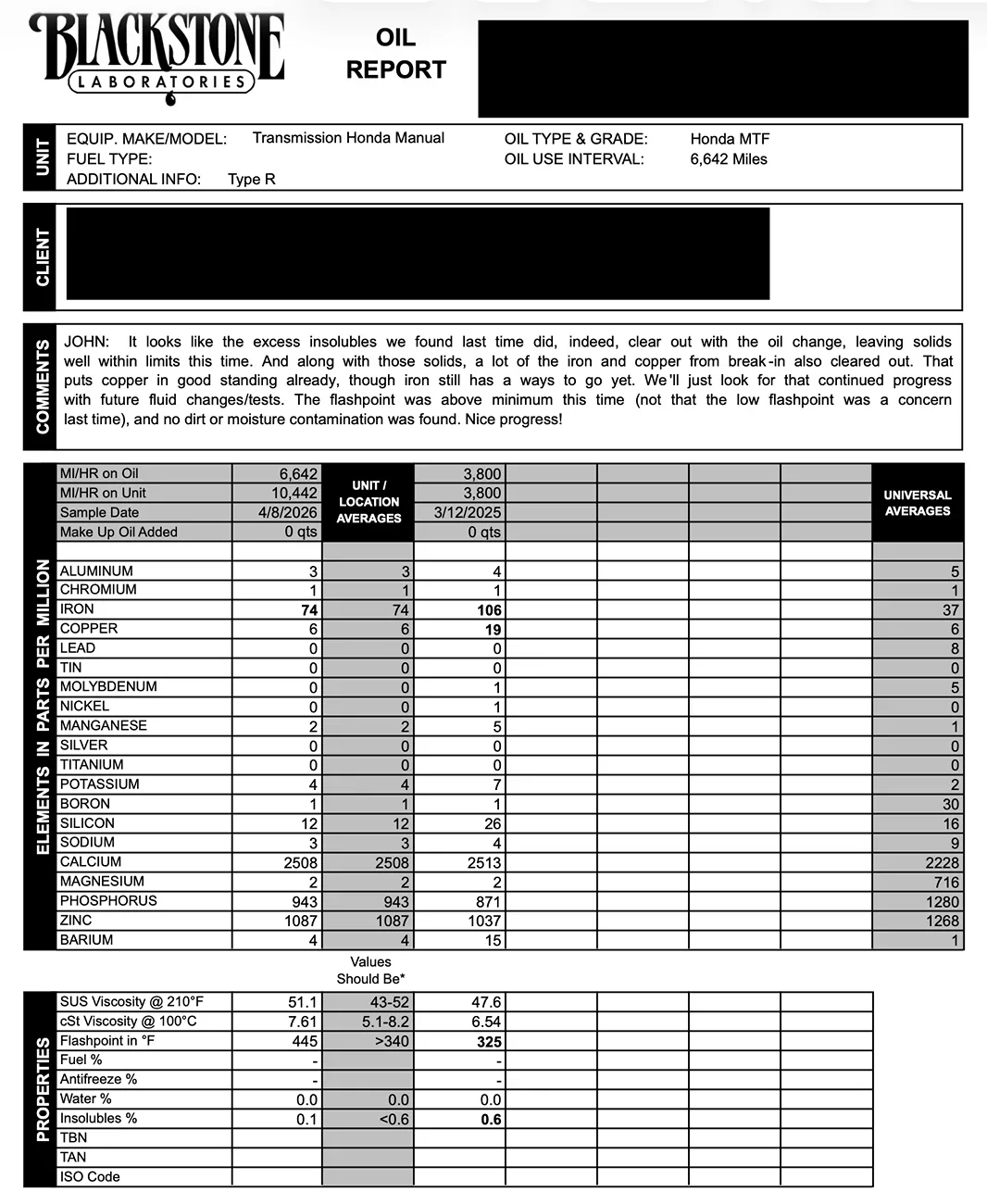
For a few smackeroos, send your used trans fluid off to a lab such as Blackstone or SPEEDiagnostix and find out what wear metals are floating around in there. They will send you a UOA or Used Oil Analysis looking something like this:

11th Gen Honda Civic Correcting the record on manual transmission fluid disinfo 1776891318000-d


Credit to @johnloov for that UOA.

What to look for in third party fluids

This could be an entire book, so I'll try to keep it concise:
  • API Category - GL-4 vs GL-5
    • GL-4 gear oils have roughly half the EP additives as GL-5 gear oils. The reason for this is application: GL-5 gear oils are broadly intended for use with hypoid differentials, such as those found in vehicles with longitudinal engine layouts and rear differentials on AWD applications. Hypoid differentials have very specific EP additive requirements for longevity, and the primary additive used is sulphur-phosphorus (S-P). This is bad for manual transmissions in two ways: one, it's too slippery for the synchronizers to work properly. Two, the S-P additive chemically attacks yellow metals like brass and bronze found in synchronizers. We don't have a hypoid differential in our cars, so there is no reason to ever use a GL-5 gear oil.
    • Some oils will claim both GL-4 and GL-5 compatibility. I believe these are formulated for transaxles that do have a hypoid gear, and they are best avoided due to the compromised nature of the additives. There need to be additional additives present to offset/passivate the higher levels of S-P additive.
    • In short, always use a GL-4 gear oil.
  • Oil viscosity
    • Honda MTF is quite thin, somewhere between a 70W-75 and a straight 70W.
    • If that sounds thick, it's not. It's closer to 0W-20 motor oil, however gear oils and motor oils use different scales in order to avoid customer confusion.
    • Using a gear oil close to the Honda MTF spec is likely a good idea if you live in an area that gets extremely cold winters.
    • Going up in SAE oil weight may be a good idea if you never deal with extreme cold, or you track your car regularly.
    • I cover various fluids organized by oil weight in this thread.
  • Additives
    • Third party oil blends, just like the first party Honda blend, are proprietary. You aren't going to be able to easily find out whether a given blend is "right" for your application by looking at some ingredient label, simply because that information is tightly controlled.
    • What you can do is put some trust in a couple of things:
      • Manufacturer recommendations: Red Line for instance makes quite a few GL-4 gear oils, but the one they recommend in lieu of Honda MTF is Red Line MTL (75W-80 viscosity.) None of their other GL-4 gear oils are directly recommended for the Civic Type R.
      • Manufacturer recommendations, part 2: If the oil manufacturer is advertising the gear oil for use in transmissions that are very unlike your transmission, then it's likely not the most suitable option out there. There's nothing to win by being a hipster and running gear oil intended for a dual-clutch transmission, simply because it says its for both DCT and manual transmissions. While DCT applications have a lot in common with our cars, they also have different needs such as running wet clutches. This is just one example, another is the different requirements of hypoid differentials that I covered above.
      • End user experience:
        • If you can find other people posting UOA, great! That's indicative of how the oil's anti-wear additives perform.
        • If you can find other people posting about shift feel, also great! That's indicative of how the oil's friction modifier additives perform.
        • If you can find other people posting about cold weather performance, extra great! That's indicative of how the oil's viscosity and VII additives perform.
Fighting examples of disinfo

I'm going to add to this thread when I run across disinfo (here and elsewhere) and include a rebuttal.
 
Last edited:

cryptolime

Senior Member
Joined
Oct 21, 2023
Threads
49
Messages
682
Reaction score
341
Location
Wilmington, NC
Vehicle(s)
2023 Civic Si
I've seen Torco MTF recommended in the past, but apparently they reformulated from GL-4 to GL-5 and it did not do well my trans. Ended up back on Honda MTF. Kind of dumb that they would do that.

GL-5 fluids never did well in any of my past manuals either. too slick for the synchros.
 
Last edited:
OP
OP

Spart

Senior Member
Joined
May 31, 2025
Threads
5
Messages
243
Reaction score
338
Location
Midwest
Vehicle(s)
2025 Integra Type S
Found in the wild:

75W-80 is not the correct viscosity for transmissions with synchros, which the Civic, Civic Si and Sports Hatch (as well Accord) have in their MT's. "Gear Oil", although that is what it is technically is not the correct term for this particular transmission (Civic). Toyota Manual Transmissions (Corolla etc) use 75W-80, and that is referred to as Gear Oil, but the Civic transmissions use Synchromesh, which is 5W30. There are people that use 75W 80 in their Civic's and say it works, but long term they are probably going to damage their synchros. Honda OEM MT is also 30 weight, at least that is what Honda told me
Alright, I'm not completely sure what's going on here that led to this.

Could be multiple things. Let's steel man this argument.

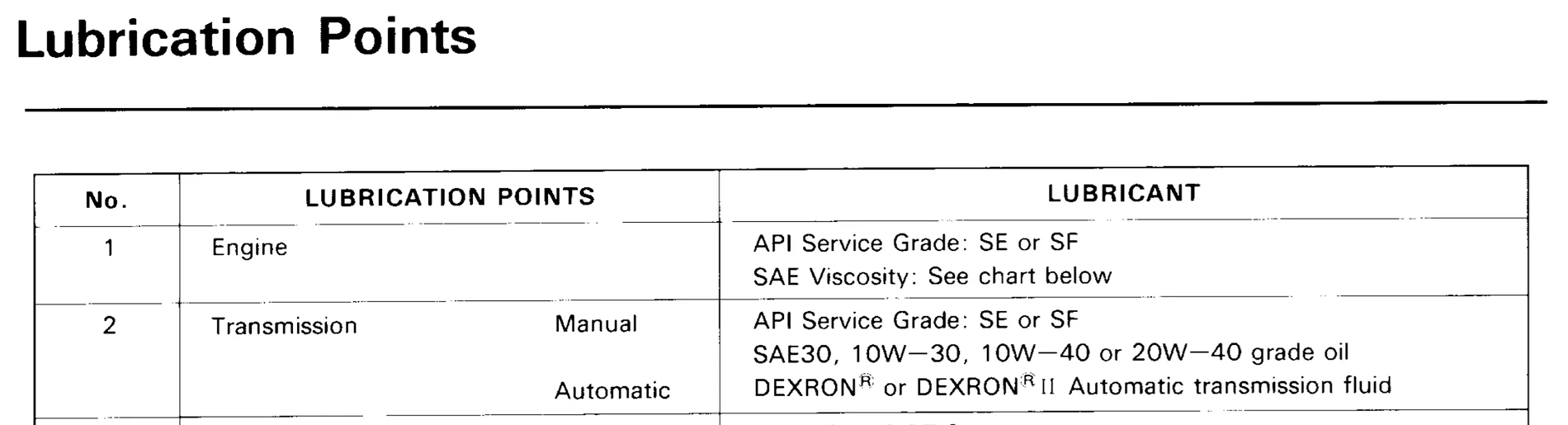
Honda (and other manufacturers) actually used to specify motor oil as the proper lubricant for manual transmissions in decades past. Meaning the SAE weight of the oil would be on the motor oil scale, not the gear oil scale.

For example, let's look at the service manual for a 88-91 Civic:

11th Gen Honda Civic Correcting the record on manual transmission fluid disinfo 1776908738835-tq

11th Gen Honda Civic Correcting the record on manual transmission fluid disinfo 1776908805565-bu


So up until about 31 years ago, OP's information would have been (sort of) correct. Thanks for putting that on the internet, OP.

The problem is that about 30 years ago, Honda introduced a dedicated fluid for manual transmissions:: the original Honda MTF was first specified for the Civic in 1996. Witness the 1996-2000 Civic Service Manual:

11th Gen Honda Civic Correcting the record on manual transmission fluid disinfo 1776909784681-ft


11th Gen Honda Civic Correcting the record on manual transmission fluid disinfo 1776909412596-pc


"Stiffer shifting because it does not contain the proper additives" - you don't say!

Now, let's address this:

Honda OEM MT is also 30 weight, at least that is what Honda told me
I'm sure the lube guy at the local Honda dealership told OP that. The mistake is conflating the local lube guy with the $30,000,000,000 global enterprise.

Here's the actual truth: the viscosity of virgin Honda MTF has been measured at anywhere from 6.96-7.6 cSt @ 100°C.

Meanwhile, here are the viscosity ranges for motor oil at 100°C:

xW-20: 6.9-9.3
xW-30: 9.3-12.5
xW-40: 12.5-16.3
xW-50 16.3-21.9

(The second number in a grade like 5W-30 represents the hot viscosity applicable at 100°C, the first number that I have indicated with "xW" has to do with winter performance and isn't relevant here. The "W" actually stands for "Winter" and not "Weight" in a multi-grade oil.)

Huh. Looks like Honda MTF (at least the recent formulation of it) is closer to a 5W-20 or 0W-20 motor oil, not a 30 weight.

But really, Honda MTF is not a motor oil. Honda MTF is a gear oil. And thus, the great confusion between gear oil viscosity and motor oil viscosity.

If you're used to dealing with something like 10W-30 and then you hear about a "70W-75" you might think that the 70W-75 must be WAY thicker than 10W-30. Like, at least twice as thick.

Nope. 70W-75 gear oil is less viscous than 10W-30 gear oil.

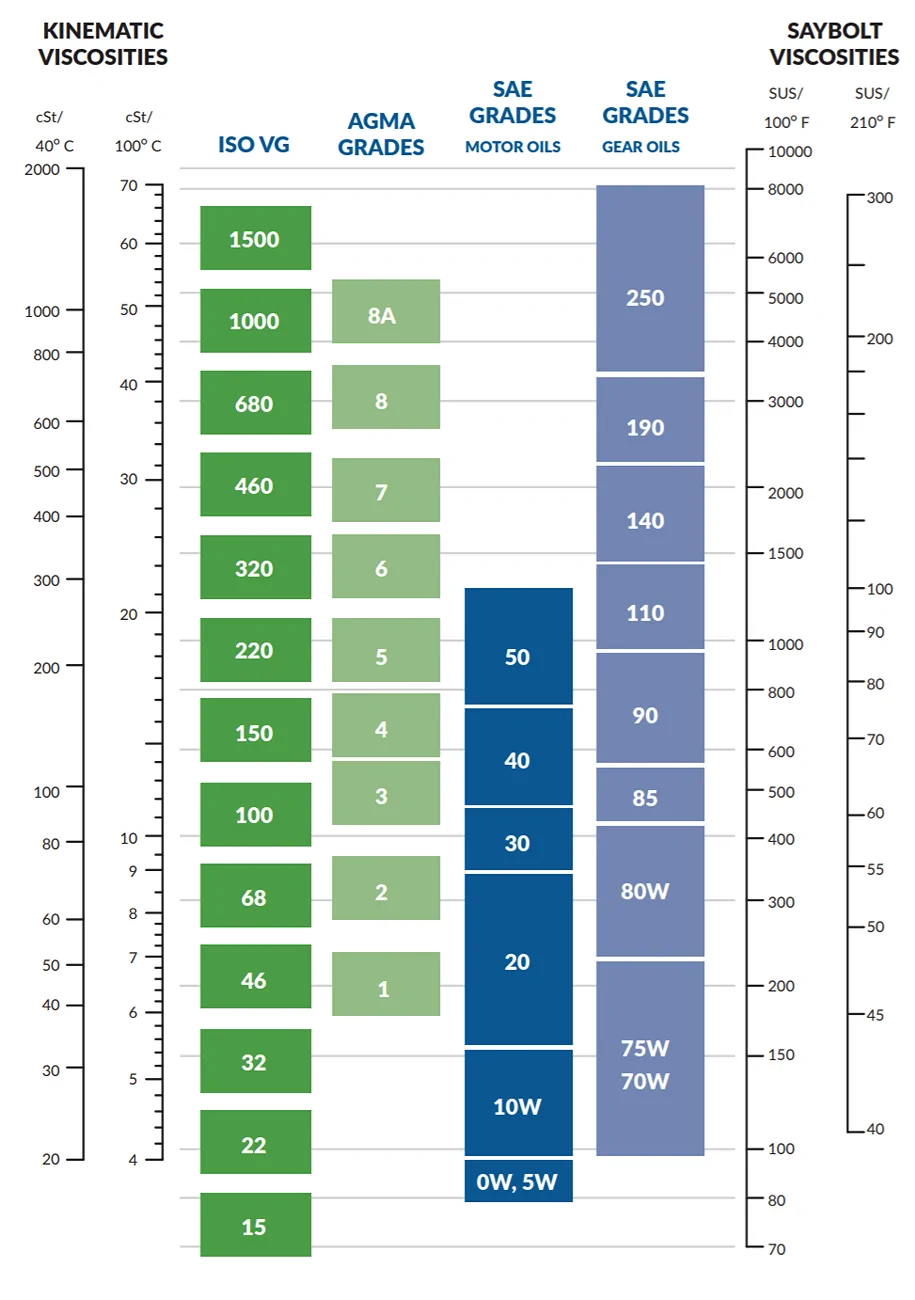
Perhaps the one favor SAE did for us on making gear oils less ambiguous was using a second, non-overlapping range of numbers for gear oils. Witness:


11th Gen Honda Civic Correcting the record on manual transmission fluid disinfo 1776910581380-w7


So as a dedicated gear oil, Honda MTF sits right on the line between 80W and 70W/75W.

Now, if only they could have done us a similar solid and made GL-4 and GL-5 more distinct from each other.

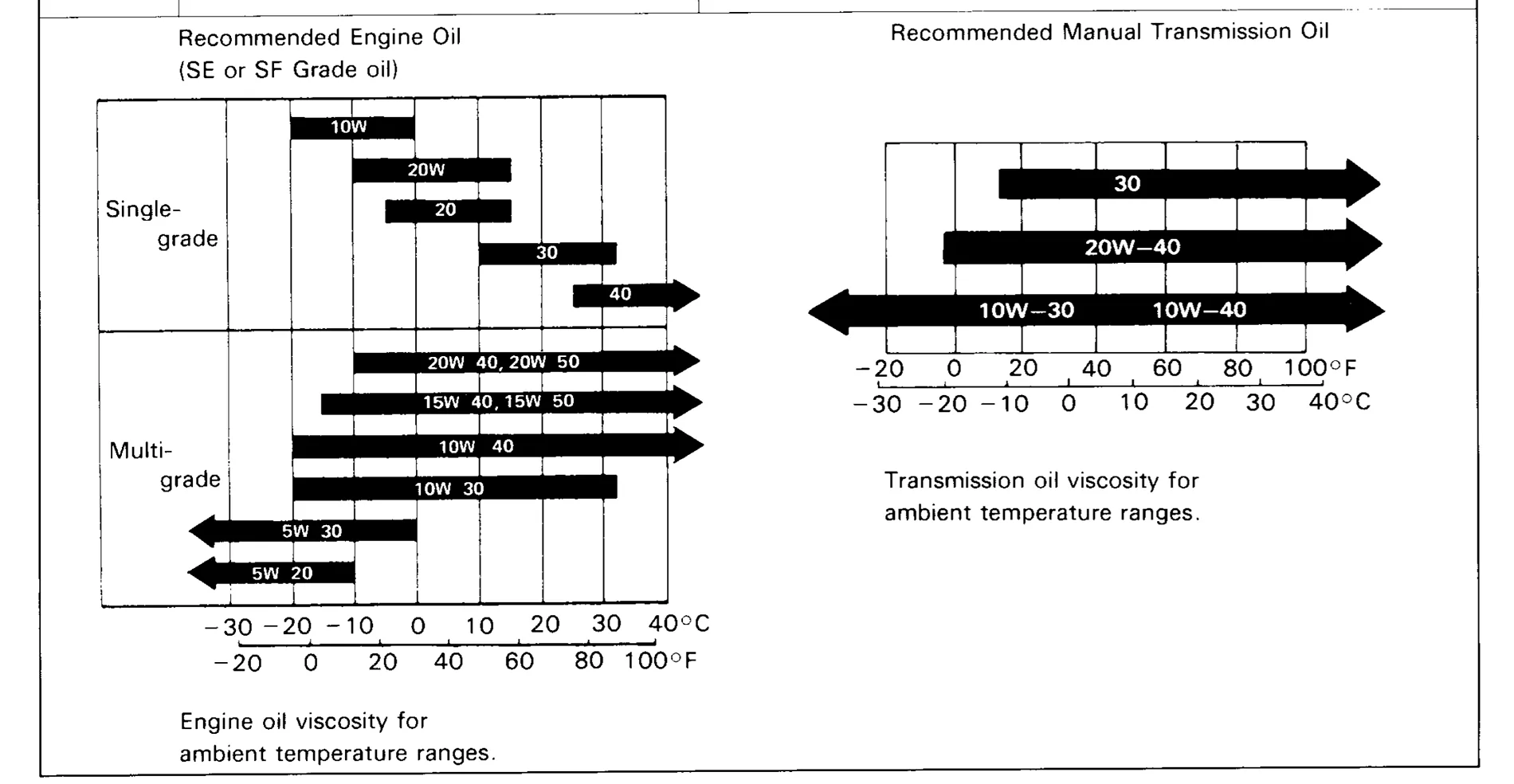
Now, I would like to revisit this chart for a moment because there's a lost bit of truth inside of it:

11th Gen Honda Civic Correcting the record on manual transmission fluid disinfo 1776908805565-bu


Prior to government regulations becoming... let us say - omnipresent - there was a time when this style of chart with temperature on the X axis was used in virtually every vehicle's owner's manual.

You 'member? I 'member.

This is no less true today. The answer to "what viscosity should I use" depends as much on your ambient temperature range as anything. That applies to gear oil and motor oil equally.

I hope this clears that up. Link to this post the next time you hear someone claim that the proper oil is "30 weight" or whatever.
 
Last edited:

AZCWTypeR

Senior Member
Joined
Feb 6, 2024
Threads
6
Messages
450
Reaction score
350
Location
Yavapi County, AZ
Vehicle(s)
2024 Type R
As an FYI, Honda just spec'd 10W-40 motor oil in the 1980's thru early 1990's for manual transmissions. I used Mobil 1 back then.

Unfortunately one of the Big 3 complained zinc-phosphate was ruining their catalytic converters (from excess oil consumption), so motor oil became very specific. Motor oil no longer worked in manual transmissions and motorcycles. Shifting got very sticky (personal experience).


cryptolime

Senior Member
Joined
Oct 21, 2023
Threads
49
Messages
682
Reaction score
341
Location
Wilmington, NC
Vehicle(s)
2023 Civic Si
@Spart what would you consider running as an aftermarket MTF? I have some Redline MTL, but I've been hesitant to try it after my experience with Torco. Although, Redline is a GL-4, so should work better. but, I haven't had any issues with Honda MTF, so no real reason to switch it up.

I've used Redline MTFs in my past cars (MTL and MT-90) with great success.
 
OP
OP

Spart

Senior Member
Joined
May 31, 2025
Threads
5
Messages
243
Reaction score
338
Location
Midwest
Vehicle(s)
2025 Integra Type S
As an FYI, Honda just spec'd 10W-40 motor oil in the 1980's thru early 1990's for manual transmissions. I used Mobil 1 back then.

Unfortunately one of the Big 3 complained zinc-phosphate was ruining their catalytic converters (from excess oil consumption), so motor oil became very specific. Motor oil no longer worked in manual transmissions and motorcycles. Shifting got very sticky (personal experience).
Not just 10W-40 though. The service manual called for "straight" 30, 10W-30, 10W-40, or 20W-40 depending on ambient temps:

1776908738835-tq.webp
 
OP
OP

Spart

Senior Member
Joined
May 31, 2025
Threads
5
Messages
243
Reaction score
338
Location
Midwest
Vehicle(s)
2025 Integra Type S
@Spart what would you consider running as an aftermarket MTF? I have some Redline MTL, but I've been hesitant to try it after my experience with Torco. Although, Redline is a GL-4, so should work better. but, I haven't had any issues with Honda MTF, so no real reason to switch it up.

I've used Redline MTFs in my past cars (MTL and MT-90) with great success.
Redline MTL is what is in my ITS right now and it's been fantastic. The only thing I haven't tried it in is extreme cold. We didn't get another major cold snap, so I've only experienced it down to about -5°F or so. It was perfectly fine at those temps.

I also only have maybe 1000 miles on it, so we'll see how the longevity goes. I've had MT-90 in my truck for a couple of years now. So far, so good - and the MT-90 is much better than the OEM Toyota fluid in my Tacoma in extreme cold weather to boot.
 
OP
OP

Spart

Senior Member
Joined
May 31, 2025
Threads
5
Messages
243
Reaction score
338
Location
Midwest
Vehicle(s)
2025 Integra Type S
Found in the wild:

Are friction modifiers necessary on helical LSDs?
I actually had this question before buying their Synchromesh and emailed Amsoil support, and they told me that the LSD is independent of the MT. Meaning the fluid from the transmission does not lubricate the LSD.
And:

Why are people using amsoil synchromesh when on their website it says not to use with limited slip? I just put amsoil synchromesh in, wish I knew this before.
Let's address these together.

The confusion here stems from the fact that there are two types of commonly-used LSDs equipped in factory cars, and only one of them has specific fluid requirements.

There's additional confusion because there are two H-words that sound similar and are easily confused: Hypoid and Helical. As with the two types of LSD, only one of them has specific fluid requirements.

The Civic Type R has neither type that requires a special fluid. Further, the fluids that are suitable for those special cases are really not optimal or recommended for the Civic Type R.

Clutch/Plated vs Geared (Helical/Torsen) LSD

There are two broad categories of LSD. In some LSDs, clutches or plates are used that slip against each other when there is a differential in wheel speed, and the friction from that slippage ensures that some torque is sent to the wheel that's spinning slower. Because these clutches or plates are submerged in the same fluid the differential is in, their operation and effectiveness are affected by the properties of the gear oil. These differentials can experience "chatter" when the wrong gear oil is used, meaning the clutches/plates will grab, then slip, grab, then slip. This is undesirable and some gear oils will include a friction modifier specifically to eliminate chatter while ensuring that adequate torque splitting occurs. Some OEMs will have a regular gear oil as well as an LSD additive that they specify. None of this is applicable to our cars, because they are not equipped with a clutch/plate type LSD.

This point bears repeating: do not use limited slip friction modifier additives. These are made for an entirely different type of limited slip than the one in our cars.

The type of LSD that our cars have is of the geared variety. Ours are "helical" LSDs, but "geared" also covers "Torsen" LSDs that use different gear geometry. Regardless, geared LSDs use geometry, mechanical disadvantage, and friction to split torque. They are compatible with a much broader range of gear oils than clutch/plate type LSDs. If you ask Torsen about this, they will tell you to run whatever makes your ring gear or transmission happy:

In truth, a Torsen differential typically isn’t that fussy about which lubricant you choose – within reason. A Type-2 or T-2R model will operate in really any common lubricant, ranging from ATF to heavy weight gear oil.
MFactory, a supplier of aftermarket helical LSDs for Honda, has this to say:

Limited-slip Friction Modifier must NOT be used, as Torsen style LSD's rely on friction in order to function.
It's worth pointing out that the differential itself is compatible with GL-5 gear oils, and you will see this type of differential used in RWD applications that have a hypoid gear that calls for GL-5. This is not a reason to use GL-5, the helical diff is compatible with it, but does not require it. It's perfectly fine in a GL-4 oil, and required for our transmission that shares oil with the differential.

Helical vs Hypoid

I bring this distinction up because it's easy to get the two conflated, and they both come up when discussing gear oil.

"Helical" refers to the style of geared LSD that is in our cars. It does not require special fluid additives.

"Hypoid" refers to the type of gear geometry used to redirect torque at a right angle. Think of the rear differential on a front-engined vehicle - a driveshaft parallel to the direction of motion inputs torque to axles rotating perpendicular to the direction of motion. A hypoid gear is commonly used to achieve this, and hypoid gears have specific fluid requirements for longevity - usually boiled down to API GL-5 classification.

There are no hypoid gears in our transmissions - everything is already rotating perpendicular to the direction of motion, so there's no need to redirect torque at a right angle. In fact, the additives used for hypoid gears (commonly found in GL-5 gear oils) are usually not compatible with the yellow metals used in synchronizers. This is the reason you want to use a GL-4 gear oil in our transmissions.

So let's revisit:

Why are people using amsoil synchromesh when on their website it says not to use with limited slip? I just put amsoil synchromesh in, wish I knew this before.
Amsoil should be more specific when calling this out. The exact wording they use is:

Not for use in engines, hypoid rear axles, limited-slip or wet-clutch applications.
The limited slip that Amsoil is referring to here is a clutch/plate type LSD. So this exclusion does not apply to our cars.

In summary:
  • Look for a gear oil that is not designed for limited slip applications, and do not add limited slip additives to your gear oil. Gear oils with limited slip additives will frequently have "LS" in the name, but you need to dig into the specifications to make sure what you're getting is not specifically for a limited slip, as these are virtually always referring to clutch/plate LSD types.
  • Look for a gear oil that is GL-4 and not GL-5. Our transmissions/differentials do not need GL-5, and GL-5 may cause synchronizer issues.
 

AspecR

Senior Member
First Name
Stefan
Joined
Aug 23, 2022
Threads
14
Messages
2,292
Reaction score
3,632
Location
Florida
Vehicle(s)
FL5 CTR
Found in the wild:


And:


Let's address these together.

The confusion here stems from the fact that there are two types of commonly-used LSDs equipped in factory cars, and only one of them has specific fluid requirements.

There's additional confusion because there are two H-words that sound similar and are easily confused: Hypoid and Helical. As with the two types of LSD, only one of them has specific fluid requirements.

The Civic Type R has neither type that requires a special fluid. Further, the fluids that are suitable for those special cases are really not optimal or recommended for the Civic Type R.

Clutch/Plated vs Geared (Helical/Torsen) LSD

There are two broad categories of LSD. In some LSDs, clutches or plates are used that slip against each other when there is a differential in wheel speed, and the friction from that slippage ensures that some torque is sent to the wheel that's spinning slower. Because these clutches or plates are submerged in the same fluid the differential is in, their operation and effectiveness are affected by the properties of the gear oil. These differentials can experience "chatter" when the wrong gear oil is used, meaning the clutches/plates will grab, then slip, grab, then slip. This is undesirable and some gear oils will include a friction modifier specifically to eliminate chatter while ensuring that adequate torque splitting occurs. Some OEMs will have a regular gear oil as well as an LSD additive that they specify. None of this is applicable to our cars, because they are not equipped with a clutch/plate type LSD.

This point bears repeating: do not use limited slip friction modifier additives. These are made for an entirely different type of limited slip than the one in our cars.

The type of LSD that our cars have is of the geared variety. Ours are "helical" LSDs, but "geared" also covers "Torsen" LSDs that use different gear geometry. Regardless, geared LSDs use geometry, mechanical disadvantage, and friction to split torque. They are compatible with a much broader range of gear oils than clutch/plate type LSDs. If you ask Torsen about this, they will tell you to run whatever makes your ring gear or transmission happy:


MFactory, a supplier of aftermarket helical LSDs for Honda, has this to say:


It's worth pointing out that the differential itself is compatible with GL-5 gear oils, and you will see this type of differential used in RWD applications that have a hypoid gear that calls for GL-5. This is not a reason to use GL-5, the helical diff is compatible with it, but does not require it. It's perfectly fine in a GL-4 oil, and required for our transmission that shares oil with the differential.

Helical vs Hypoid

I bring this distinction up because it's easy to get the two conflated, and they both come up when discussing gear oil.

"Helical" refers to the style of geared LSD that is in our cars. It does not require special fluid additives.

"Hypoid" refers to the type of gear geometry used to redirect torque at a right angle. Think of the rear differential on a front-engined vehicle - a driveshaft parallel to the direction of motion inputs torque to axles rotating perpendicular to the direction of motion. A hypoid gear is commonly used to achieve this, and hypoid gears have specific fluid requirements for longevity - usually boiled down to API GL-5 classification.

There are no hypoid gears in our transmissions - everything is already rotating perpendicular to the direction of motion, so there's no need to redirect torque at a right angle. In fact, the additives used for hypoid gears (commonly found in GL-5 gear oils) are usually not compatible with the yellow metals used in synchronizers. This is the reason you want to use a GL-4 gear oil in our transmissions.

So let's revisit:


Amsoil should be more specific when calling this out. The exact wording they use is:


The limited slip that Amsoil is referring to here is a clutch/plate type LSD. So this exclusion does not apply to our cars.

In summary:
  • Look for a gear oil that is not designed for limited slip applications, and do not add limited slip additives to your gear oil. Gear oils with limited slip additives will frequently have "LS" in the name, but you need to dig into the specifications to make sure what you're getting is not specifically for a limited slip, as these are virtually always referring to clutch/plate LSD types.
  • Look for a gear oil that is GL-4 and not GL-5. Our transmissions/differentials do not need GL-5, and GL-5 may cause synchronizer issues.
GL-5 transmission fluids will cause issues, particularly with the brass synchros of 1st and 2nd gear. 90% of owners should really just stick OEM, unless you car is tracked regularly, or making over 400wtq then you can look into "upgrading" the transmission fluid.


AZCWTypeR

Senior Member
Joined
Feb 6, 2024
Threads
6
Messages
450
Reaction score
350
Location
Yavapi County, AZ
Vehicle(s)
2024 Type R
Amsoil and GM Syncromesh shifted better in very cold weather (until the transmission warmed). I had to double clutch the first couple miles to avoid clashing with Honda MTL.

Honda MTL is quite fine otherwise, especially now living in the southwest.
 
OP
OP

Spart

Senior Member
Joined
May 31, 2025
Threads
5
Messages
243
Reaction score
338
Location
Midwest
Vehicle(s)
2025 Integra Type S
GL-5 transmission fluids will cause issues, particularly with the brass synchros of 1st and 2nd gear. 90% of owners should really just stick OEM, unless you car is tracked regularly, or making over 400wtq then you can look into "upgrading" the transmission fluid.
I didn't advocate for GL-5 anywhere in that post, quite the opposite.

I firmly disagree that 90% of CTR owners should stick to OEM. This is an area for improvement on the stock car with stock power and street driving.
 

AspecR

Senior Member
First Name
Stefan
Joined
Aug 23, 2022
Threads
14
Messages
2,292
Reaction score
3,632
Location
Florida
Vehicle(s)
FL5 CTR
I didn't advocate for GL-5 anywhere in that post, quite the opposite.

I firmly disagree that 90% of CTR owners should stick to OEM. This is an area for improvement on the stock car with stock power and street driving.
I know you didn't advocate for GL-5, I was affirming your very last line in the post abt GL-5 fluids. I say 90% should stick to OEM because for the most part the average CTR owner, doesn't actually do anything above basic commuting and street driving. Yes, there is improvement to be had but unless they've had a grind, the average owner already thin ks the transmission is fine and don't really give it a second thought.

If they have given it some thought then they should definitely upgrade when doing routine maintenance.
 
OP
OP

Spart

Senior Member
Joined
May 31, 2025
Threads
5
Messages
243
Reaction score
338
Location
Midwest
Vehicle(s)
2025 Integra Type S
Yes, there is improvement to be had but unless they've had a grind, the average owner already thin ks the transmission is fine and don't really give it a second thought.
You claim to speak for the average owner?

I have not had grinding, I'm not adding power, and I'm never going to track this car.

Swapping the fluid for Red Line MTL at ~4000 miles (after break in) made a VERY positive difference, on the level of the difference that the Acuity shifter made. The feel of the synchros through the shifter changed quite drastically. The OEM fluid felt inconsistent, irregular, and the shift effort was higher than it should be. Red Line MTL immediately gave me consistency, smoothness, and lessened shift effort.

The average owner of a CTR is an enthusiast almost by definition, not the plebe you imagine. Certainly if they've found this thread.

If you don't want to modify your car, don't modify your car. Instead you choose to tell other people to not modify their car. Why? Really... why?
 

AspecR

Senior Member
First Name
Stefan
Joined
Aug 23, 2022
Threads
14
Messages
2,292
Reaction score
3,632
Location
Florida
Vehicle(s)
FL5 CTR
You claim to speak for the average owner?

I have not had grinding, I'm not adding power, and I'm never going to track this car.

Swapping the fluid for Red Line MTL at ~4000 miles (after break in) made a VERY positive difference, on the level of the difference that the Acuity shifter made. The feel of the synchros through the shifter changed quite drastically. The OEM fluid felt inconsistent, irregular, and the shift effort was higher than it should be. Red Line MTL immediately gave me consistency, smoothness, and lessened shift effort.

The average owner of a CTR is an enthusiast almost by definition, not the plebe you imagine. Certainly if they've found this thread.

If you don't want to modify your car, don't modify your car. Instead you choose to tell other people to not modify their car. Why? Really... why?
Nevermind you win :thumbsup:
Sponsored


Top