Spart
Senior Member
- Thread starter
- #1
This post is intended to be a one-stop collection of info about changing the transmission fluid in the FL5 CTR or DE5 Integra Type S.
Important: when changing transmission, transfer case, or differential fluid, ALWAYS REMOVE THE FILL PLUG FIRST. If you drain your transmission and then come to find out that you cannot remove your fill plug, your car is going to be parked for a while.
OEM Fluid
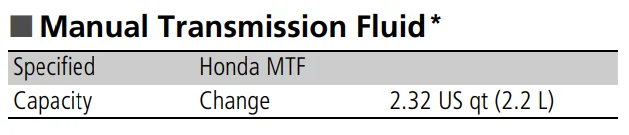
The OEM fluid in these cars is good old Honda MTF. According to the 2025 USDM Civic Hatchback owner's manual:

Honda doesn't specify a gear oil weight for this oil, however it's in the neighborhood of a straight 70W or 70W-75. Honda doesn't publish kinematic viscosities for MTF either, but these are the approximate kinematic viscosities of Honda MTF as reported by folks who have done VOA on new fluid:
7.265 cSt @ 100°C
30.70 cSt @ 40°C
Honda MTF is inoffensive but it can be improved upon. You can run any GL-4 gear oil intended for a manual transmission with a viscosity suitable for your use and expected ambient temperature range. Scroll down to the end of this post for suitable alternatives to the OEM Honda MTF.
Service Interval
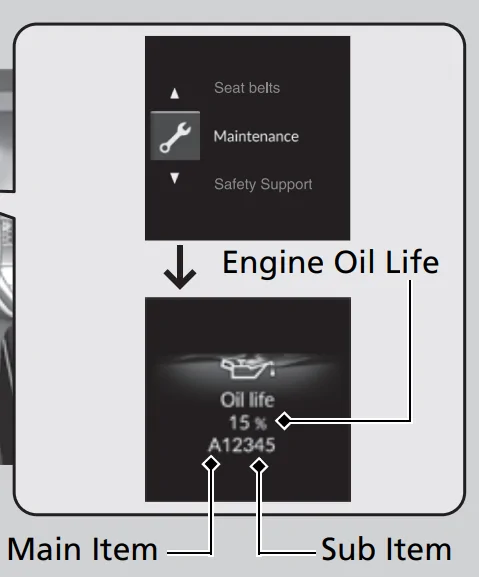
The "Honda Maintenance Minder" in these cars tracks various maintenance intervals including transmission fluid. When the car thinks it needs a transmission flush, it will show code 3 in the cluster, along with any other codes that may be active. From the 2025 USDM Civic Hatchback owner's manual:

And also:

Note blurb #4 above: "Driving in mountainous areas at very low vehicle speeds results in higher transmission temperatures. This requires transmission fluid changes more frequently than recommended by the Maintenance Minder. If you regularly drive your vehicle under these conditions, have the transmission fluid changed every 37,500 miles (60,000 km)."
According to the UK 2024 CTR manual:

Honda states in the UK CTR manual that the transmission fluid should be replaced every 75k miles under "normal" use and every 37.5k miles under "severe" use. Severe use is defined in the UK CTR manual as:

Use your own judgement. It can't hurt to change the fluid early. In particular, many people advise changing the fluid after initial break in (600-5000 miles depending on who you ask.)
Here is industry expert Lake Speed Jr. on the how and why of gear oil change intervals:
Capacity
The capacity is 2.32 US quarts per the 2025 USDM Civic hatchback owner's manual.

If you found instructions that say to just put two quarts in, those instructions are wrong. You should fill the trans until fluid starts to run out the "check" plug, and if the car is level and fully drained, this will take more than two quarts. For me, this was about 2.1 or 2.2 quarts. If you buy a fluid that comes in liters, you can probably get away with getting two liters as this will be 2.1 quarts. If you're buying a fluid that comes in quarts, you need to buy three quarts and you'll have some left over.
Drain and fill plugs
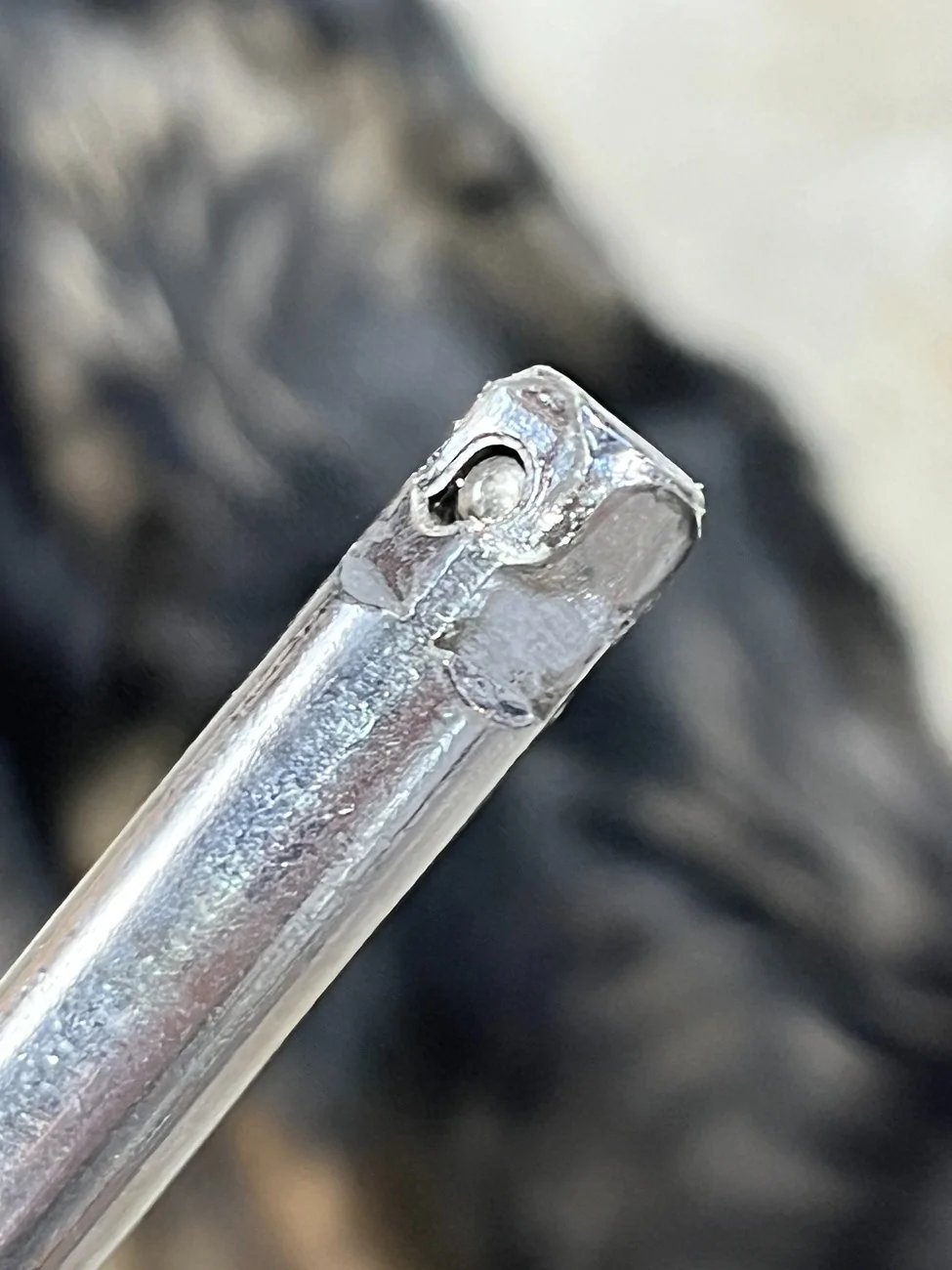
The drain and fill plugs share a crush washer and torque spec. They accept a 3/8" drive socket extension, or a 3/8" male pipe plug socket such as a Sunex 312PC. I would highly recommend a 3/8" male pipe plug socket, because I ruined one of my 3/8" drive socket extensions removing the fill plug. It stated to break at the ball detent. The fill plug is insanely tight from the factory and I'm not the only one to experience this.

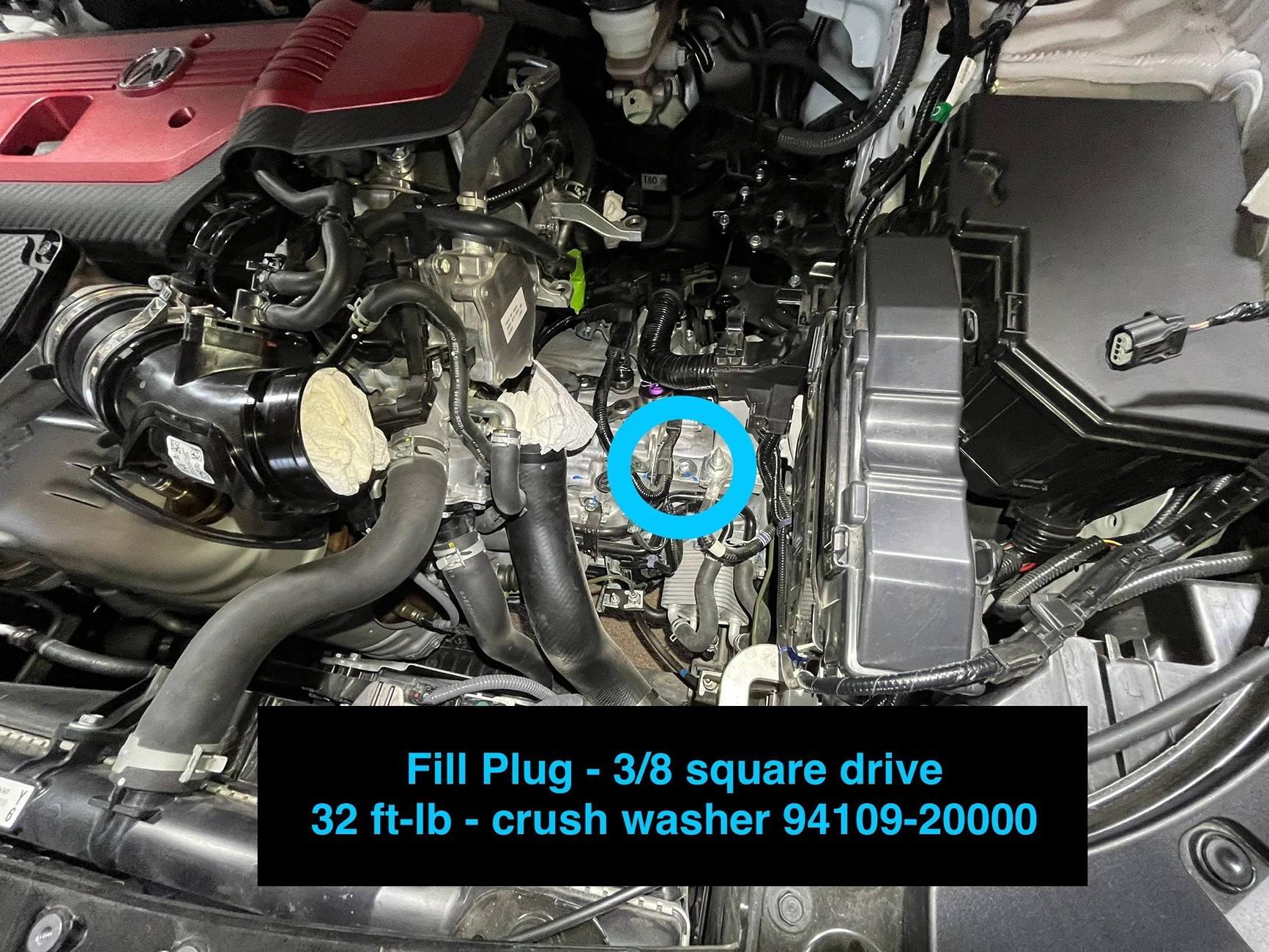
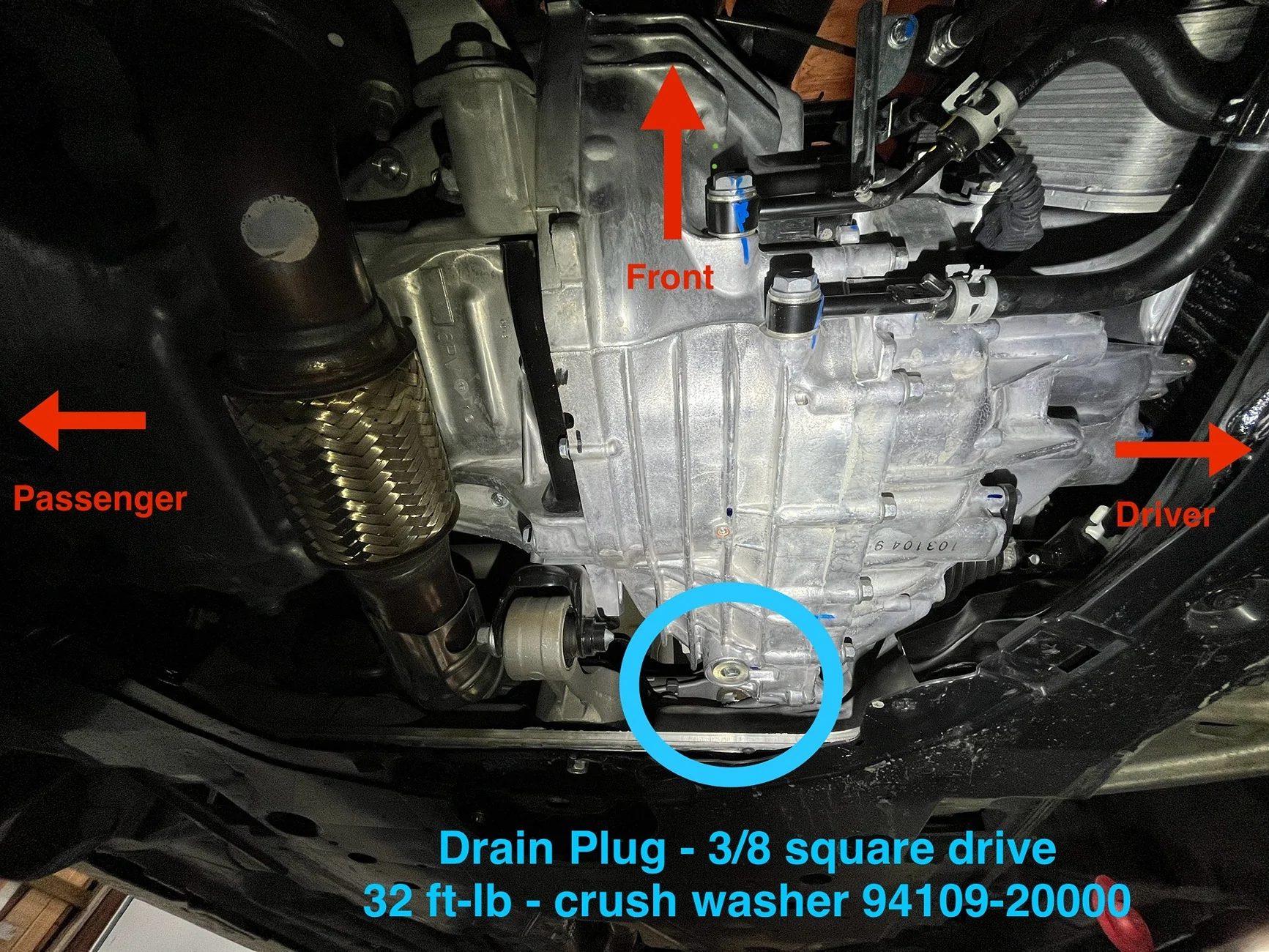
The crush washer is Honda part number 94109-20000 and you will need two of them.
These plugs should be torqued to 32 ft-lb.
Check plug
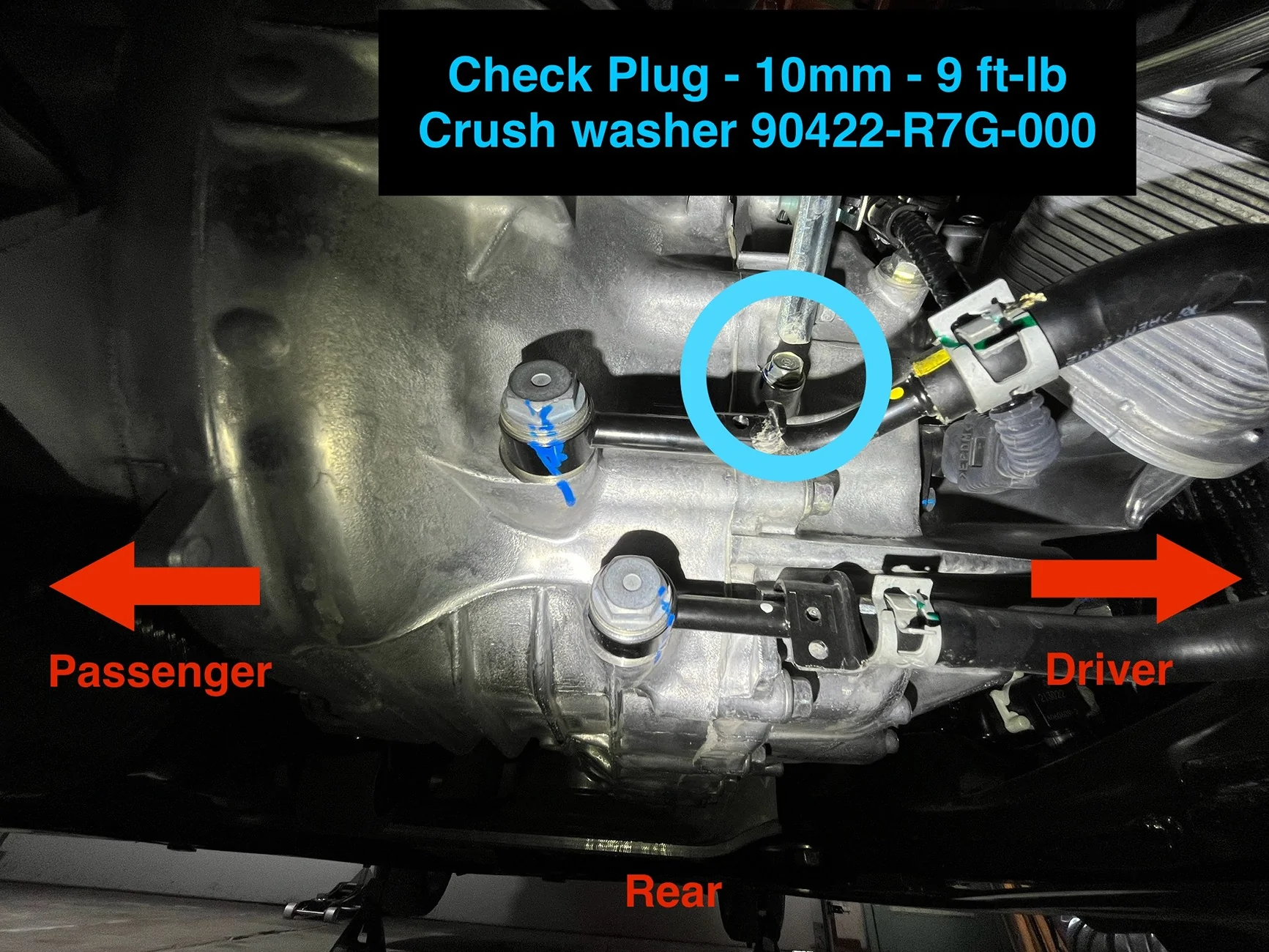
The check plug is a much smaller bolt with a 10mm hex head.
With the car level, fill the transmission with fluid until it starts to run out of the threaded hole for the check plug.
The crush washer for this plug is Honda part number 90442-R76-000.
This plug should be torqued to 9 ft-lb.
Plug locations
You will have to remove the airbox to access the fill plug, which is on the top of the transmission. For instructions on how to remove the airbox, reference the first part of Acuity's instructions for accessing the cable shifter bushings. In fact, consider replacing the cable shifter bushings at the same time, since they're nearby. You might also consider deleting your clutch master cylinder damper, which is under the battery bracket.

To access the drain and check plugs, you will need to remove the tray under the engine/trans as if you are changing the oil.
The drain plug is on the bottom of the transmission:
The check plug is on the side of the transmission facing the front of the car:
Suitable replacement fluids
While Honda MTF is recommended by the owner's manual, changing to a higher quality fluid can be an easy way to improve various aspects of your car.
Many fluids will give a smoother feel, and some may even help with the notorious Honda second gear grind. This isn't just about viscosity, it's primarily about friction modifiers and other additives.
If you are tracking your car, you may wish to use a higher viscosity fluid so that your viscosity at full operating temperature is in a more acceptable range.
If you are not tracking your car, a higher viscosity fluid may do more harm than good for the shift feel, particularly when the transmission is cold.
The most important thing is that you should use a GL-4 (and not a GL-5) fluid intended for manual transmissions.
This fluid need not have an LSD additive. While our cars do have LSD, they are helical (gear type) LSDs, and manual transmission fluids with LSD additives are intended for clutch-type LSD.
If you don't have a good reason to do so, you should not stray too far from the viscosity that Honda uses. Honda MTF is a 70W or 70W-75 oil. Using 75W-90 is a big step up from 70W-75 - it's nearly double the viscosity of Honda MTF - and it provides little benefit if you are not doing something to drive your transmission temperature to the moon - like driving on track.
When comparing a replacement fluid to Honda MTF, keep in mind that Honda MTL has these viscosity characteristics:
7.265 cSt @ 100°C *** VOA sourced from BITOG shows a range of 6.96-7.6
30.70 cSt @ 40°C
With cSt, a lower number means lower viscosity.
Regarding the 100°C viscosity figure specifically, a gear oil with a weight ending in 75 (70W-75 or straight 75W) should be in the range of 6.5-8.4 cSt @ 100°C
Fluids that closely match Honda MTF
These fluids have a viscosity range that is comparable to Honda MTF - 70W-75 or straight 75W.
If you are concerned about maintaining extreme cold weather performance under 0°F similar to the OEM Honda MTF, stick to these fluids or use Honda MTF.
BG Syncro Shift II (75W-75 GL-4)
7.11 cSt @ 100°C
37.85 cSt @ 40°C
Castrol Syntrans FE 75W
6.3 cSt @ 100°C
32.2 cSt @ 40°C
Pentosin FFL-3 (BMW MTF-LT-5 equivalent)
7 cSt @ 100°C
34.7 cSt @ 40°C
Pentosin FFL-4 (75W-80 GL-4 and BMW MTF-LT-1/2 equivalent)
7 cSt @ 100°C
34.7 cSt @ 40°C
Motul Gear Power FE 75W
5.8 cSt @ 100°C
30.7 cSt @ 40°C
Redline MT-LV (70W/75W GL-4)
6.3 cSt @ 100°C
29.9 cSt @ 40°C
Royal Purple Synchromax
7.5 cSt @ 100°C
39 cSt @ 40°C
Liqui Moly Top Tec MTF 5100 (75W)
6 cSt @ 100°C
33.1 cSt @ 40°C
Liqui Moly Top Tec MTF 5300 (70W-75)
5.9 cSt @ 100°C
30.8 cSt @ 40°C
Fluids one step thicker than Honda MTF
These fluids are in the 70W-80, 75W-80, or straight 80W range.
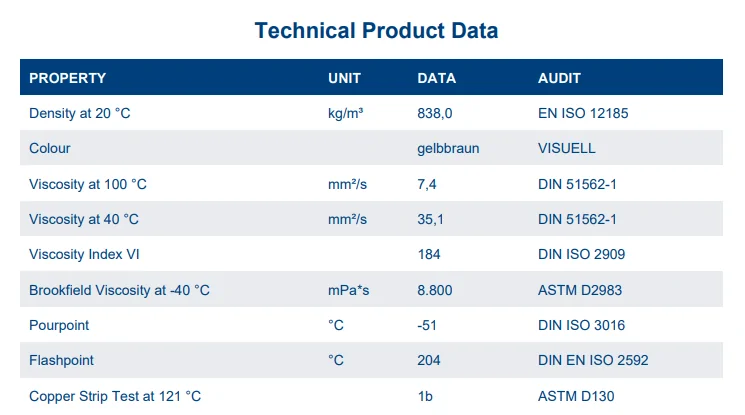
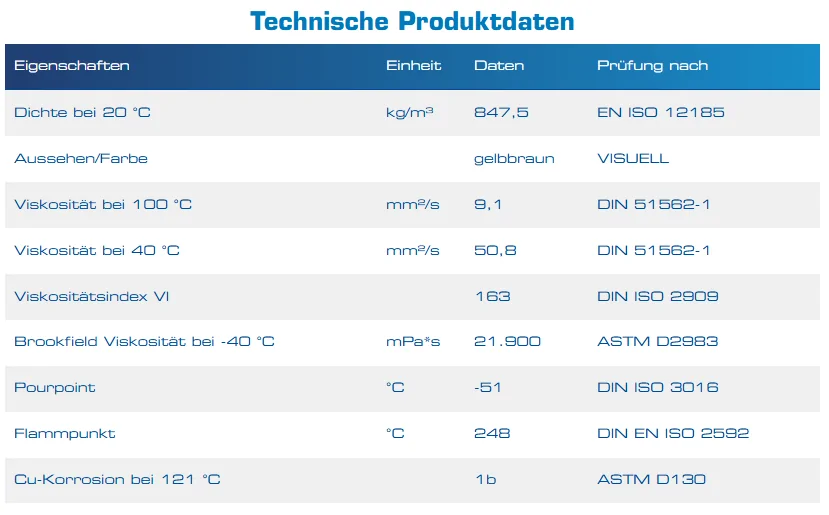
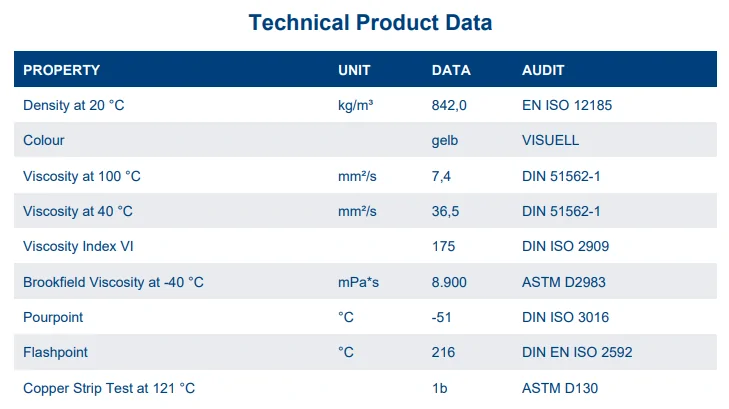
At least three of these fluids are very commonly used and recommended in our cars - ACDelco 10-4014, Redline MTL, and Amsoil 5W-30 MT Synchromesh. I am personally running Redline MTL.
Use these fluids if you do not need the best performance in sub-zero temperatures.
ACDelco Synchromesh "Friction Modified" 10-4014 (Some bottles are specifically labeled 75W-80)
10.05 cSt @ 100°C *** the MSDS for 88900399 states 9.08, not 10.05
50 cSt @ 40°C *** the MSDS for 88900399 states 41.6, not 50
ACDelco Synchromesh 10-4006 75W-80
9.2 cSt @ 100°C *** data sourced from VOA on BITOG
38-40 cSt @ 40°C *** data sourced from two different MSDS
Motul Motylgear 75W-80
10.1 cSt @ 100°C
58.8 cSt @ 40°C
Redline MTL (75W-80 GL-4)
10.4 cSt @ 100°C
50.8 cSt @ 40°C
Amsoil "5W-30" Manual Synchromesh Transmission Fluid (note this is like a 75W-80 gear oil, no clue why they use the motor oil weight.)
10.1 cSt @ 100°C
49.4 cSt @ 40°C
Liqui Moly Top Tec MTF 5200 (75W-80)
9.2 cSt @ 100°C
53 cSt @ 40°C
Fluids two steps thicker than Honda MTF
These fluids are in the 75W-85 or straight 85W range.
Only use these fluids if you do not need the best performance in sub-freezing temperatures.
Motul Motylgear 75W-85
12.6 cSt @ 100°C
82.6 cSt @ 40°C
Redline MT-85 (75W-85 GL-4)
12 cSt @ 100°C
62 cSt @ 40°C
ACDelco Manual Transmission Fluid 10-4104 (SAE 75W-85 GL-4)
Can't find definite figures for this one.
Fluids three steps thicker than Honda MTF
These fluids are in the 75W-90 or straight 90W range.
I would not recommend using these fluids if you drive in winter weather at all. However, they could be excellent for track use.
Motul Motylgear 75W-90
14.2 cSt @ 100°C
85.4 cSt @ 100°C
Redline MT-90 (75W-90 GL-4)
15.5 cSt @ 100°C
82 cSt @ 40°C
Amsoil 75W-90 Manual Transmission & Transaxle Gear Lube
14.0 cSt @ 100°C
80.3 cSt @ 40°C
Liqui Moly Top Tec MTF 5400 (75W-90)
15.5 cSt @ 100°C
88.0 cSt @ 40°C
I can't decide on a fluid - help!
Viscosity is not the only thing that matters for shift feel with a manual trans, though it can make a big difference in cold climates. Friction modifiers will alter the synchro feel, which is most of what you're feeling through the shifter. This is why what feels "right" in every gearbox will be subjective and oil from one brand won't feel the same as equivalent weight oil from another brand.
Climate and use also matters. If you live somewhere that doesn't really get winter, or you track your car, 75W-90 might be the ticket. But if you want like for like with OE, I would stick to 70W, 75W, or 75W-80 oils and pick your favorite based on friction modifiers (shift feel.)
Forum members have reported excellent results with Amsoil "5W-30" (actually 75W-80) Manual Synchromesh Transmission Fluid, Redline MTL, and ACDelco Synchromesh 10-4014.
In particular, ACDelco 10-4014 has long been a remedy for second gear grind in Hondas of various generations.
Important: when changing transmission, transfer case, or differential fluid, ALWAYS REMOVE THE FILL PLUG FIRST. If you drain your transmission and then come to find out that you cannot remove your fill plug, your car is going to be parked for a while.
OEM Fluid
The OEM fluid in these cars is good old Honda MTF. According to the 2025 USDM Civic Hatchback owner's manual:
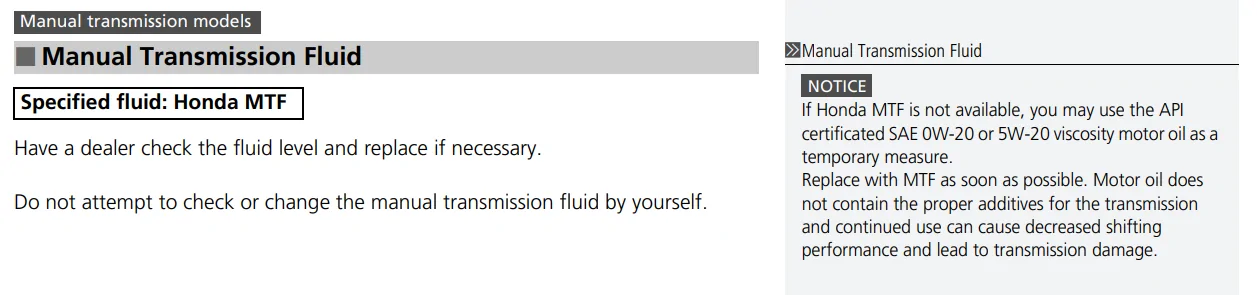
Honda doesn't specify a gear oil weight for this oil, however it's in the neighborhood of a straight 70W or 70W-75. Honda doesn't publish kinematic viscosities for MTF either, but these are the approximate kinematic viscosities of Honda MTF as reported by folks who have done VOA on new fluid:
7.265 cSt @ 100°C
30.70 cSt @ 40°C
Honda MTF is inoffensive but it can be improved upon. You can run any GL-4 gear oil intended for a manual transmission with a viscosity suitable for your use and expected ambient temperature range. Scroll down to the end of this post for suitable alternatives to the OEM Honda MTF.
Service Interval
The "Honda Maintenance Minder" in these cars tracks various maintenance intervals including transmission fluid. When the car thinks it needs a transmission flush, it will show code 3 in the cluster, along with any other codes that may be active. From the 2025 USDM Civic Hatchback owner's manual:
And also:
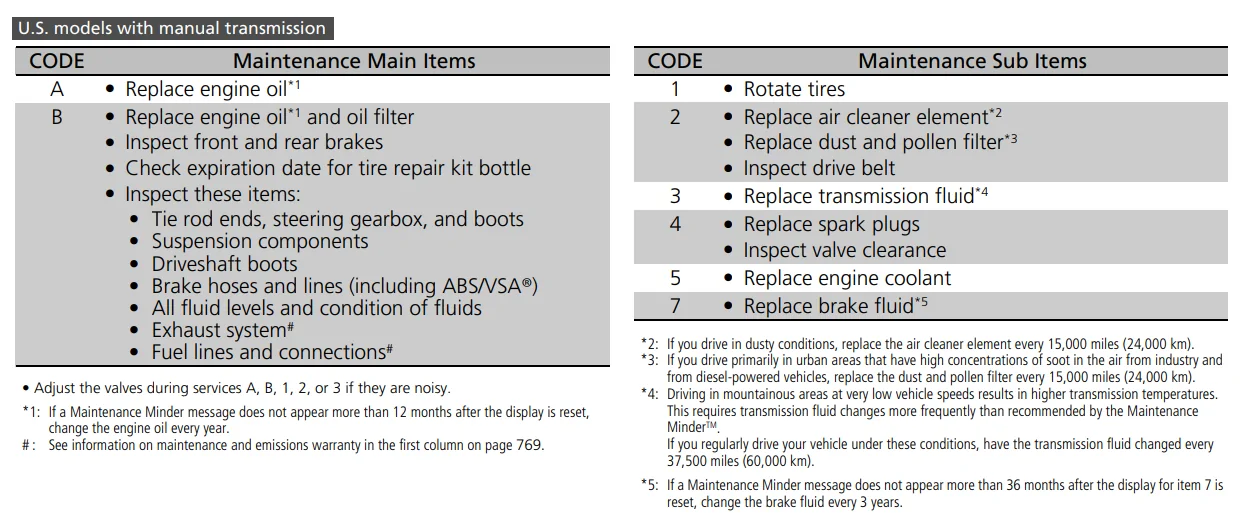
Note blurb #4 above: "Driving in mountainous areas at very low vehicle speeds results in higher transmission temperatures. This requires transmission fluid changes more frequently than recommended by the Maintenance Minder. If you regularly drive your vehicle under these conditions, have the transmission fluid changed every 37,500 miles (60,000 km)."
According to the UK 2024 CTR manual:

Honda states in the UK CTR manual that the transmission fluid should be replaced every 75k miles under "normal" use and every 37.5k miles under "severe" use. Severe use is defined in the UK CTR manual as:
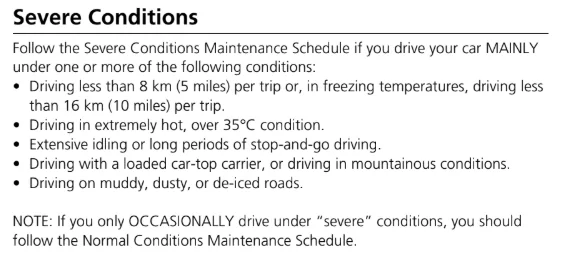
Use your own judgement. It can't hurt to change the fluid early. In particular, many people advise changing the fluid after initial break in (600-5000 miles depending on who you ask.)
Here is industry expert Lake Speed Jr. on the how and why of gear oil change intervals:
Capacity
The capacity is 2.32 US quarts per the 2025 USDM Civic hatchback owner's manual.
If you found instructions that say to just put two quarts in, those instructions are wrong. You should fill the trans until fluid starts to run out the "check" plug, and if the car is level and fully drained, this will take more than two quarts. For me, this was about 2.1 or 2.2 quarts. If you buy a fluid that comes in liters, you can probably get away with getting two liters as this will be 2.1 quarts. If you're buying a fluid that comes in quarts, you need to buy three quarts and you'll have some left over.
Drain and fill plugs
The drain and fill plugs share a crush washer and torque spec. They accept a 3/8" drive socket extension, or a 3/8" male pipe plug socket such as a Sunex 312PC. I would highly recommend a 3/8" male pipe plug socket, because I ruined one of my 3/8" drive socket extensions removing the fill plug. It stated to break at the ball detent. The fill plug is insanely tight from the factory and I'm not the only one to experience this.
The crush washer is Honda part number 94109-20000 and you will need two of them.
These plugs should be torqued to 32 ft-lb.
Check plug
The check plug is a much smaller bolt with a 10mm hex head.
With the car level, fill the transmission with fluid until it starts to run out of the threaded hole for the check plug.
The crush washer for this plug is Honda part number 90442-R76-000.
This plug should be torqued to 9 ft-lb.
Plug locations
You will have to remove the airbox to access the fill plug, which is on the top of the transmission. For instructions on how to remove the airbox, reference the first part of Acuity's instructions for accessing the cable shifter bushings. In fact, consider replacing the cable shifter bushings at the same time, since they're nearby. You might also consider deleting your clutch master cylinder damper, which is under the battery bracket.
To access the drain and check plugs, you will need to remove the tray under the engine/trans as if you are changing the oil.
The drain plug is on the bottom of the transmission:
The check plug is on the side of the transmission facing the front of the car:
Suitable replacement fluids
While Honda MTF is recommended by the owner's manual, changing to a higher quality fluid can be an easy way to improve various aspects of your car.
Many fluids will give a smoother feel, and some may even help with the notorious Honda second gear grind. This isn't just about viscosity, it's primarily about friction modifiers and other additives.
If you are tracking your car, you may wish to use a higher viscosity fluid so that your viscosity at full operating temperature is in a more acceptable range.
If you are not tracking your car, a higher viscosity fluid may do more harm than good for the shift feel, particularly when the transmission is cold.
The most important thing is that you should use a GL-4 (and not a GL-5) fluid intended for manual transmissions.
This fluid need not have an LSD additive. While our cars do have LSD, they are helical (gear type) LSDs, and manual transmission fluids with LSD additives are intended for clutch-type LSD.
If you don't have a good reason to do so, you should not stray too far from the viscosity that Honda uses. Honda MTF is a 70W or 70W-75 oil. Using 75W-90 is a big step up from 70W-75 - it's nearly double the viscosity of Honda MTF - and it provides little benefit if you are not doing something to drive your transmission temperature to the moon - like driving on track.
When comparing a replacement fluid to Honda MTF, keep in mind that Honda MTL has these viscosity characteristics:
7.265 cSt @ 100°C *** VOA sourced from BITOG shows a range of 6.96-7.6
30.70 cSt @ 40°C
With cSt, a lower number means lower viscosity.
Regarding the 100°C viscosity figure specifically, a gear oil with a weight ending in 75 (70W-75 or straight 75W) should be in the range of 6.5-8.4 cSt @ 100°C
Fluids that closely match Honda MTF
These fluids have a viscosity range that is comparable to Honda MTF - 70W-75 or straight 75W.
If you are concerned about maintaining extreme cold weather performance under 0°F similar to the OEM Honda MTF, stick to these fluids or use Honda MTF.
BG Syncro Shift II (75W-75 GL-4)
7.11 cSt @ 100°C
37.85 cSt @ 40°C
Castrol Syntrans FE 75W
6.3 cSt @ 100°C
32.2 cSt @ 40°C
Pentosin FFL-3 (BMW MTF-LT-5 equivalent)
7 cSt @ 100°C
34.7 cSt @ 40°C
Pentosin FFL-4 (75W-80 GL-4 and BMW MTF-LT-1/2 equivalent)
7 cSt @ 100°C
34.7 cSt @ 40°C
Motul Gear Power FE 75W
5.8 cSt @ 100°C
30.7 cSt @ 40°C
Redline MT-LV (70W/75W GL-4)
6.3 cSt @ 100°C
29.9 cSt @ 40°C
Royal Purple Synchromax
7.5 cSt @ 100°C
39 cSt @ 40°C
Liqui Moly Top Tec MTF 5100 (75W)
6 cSt @ 100°C
33.1 cSt @ 40°C
Liqui Moly Top Tec MTF 5300 (70W-75)
5.9 cSt @ 100°C
30.8 cSt @ 40°C
Fluids one step thicker than Honda MTF
These fluids are in the 70W-80, 75W-80, or straight 80W range.
At least three of these fluids are very commonly used and recommended in our cars - ACDelco 10-4014, Redline MTL, and Amsoil 5W-30 MT Synchromesh. I am personally running Redline MTL.
Use these fluids if you do not need the best performance in sub-zero temperatures.
ACDelco Synchromesh "Friction Modified" 10-4014 (Some bottles are specifically labeled 75W-80)
10.05 cSt @ 100°C *** the MSDS for 88900399 states 9.08, not 10.05
50 cSt @ 40°C *** the MSDS for 88900399 states 41.6, not 50
*** Note that the "friction modified" is not in reference to LSD additive. This gear oil was specifically developed to resolve gear grind issues in the GM NV1500 transmission, and has been used to similar effect in Honda transmissions (among others) for years. Almost all manual transmission fluids have friction modifiers, ACDelco 10-4014 and equivalents just have more of them.
ACDelco Synchromesh 10-4006 75W-80
9.2 cSt @ 100°C *** data sourced from VOA on BITOG
38-40 cSt @ 40°C *** data sourced from two different MSDS
Motul Motylgear 75W-80
10.1 cSt @ 100°C
58.8 cSt @ 40°C
Redline MTL (75W-80 GL-4)
10.4 cSt @ 100°C
50.8 cSt @ 40°C
Amsoil "5W-30" Manual Synchromesh Transmission Fluid (note this is like a 75W-80 gear oil, no clue why they use the motor oil weight.)
10.1 cSt @ 100°C
49.4 cSt @ 40°C
Liqui Moly Top Tec MTF 5200 (75W-80)
9.2 cSt @ 100°C
53 cSt @ 40°C
Fluids two steps thicker than Honda MTF
These fluids are in the 75W-85 or straight 85W range.
Only use these fluids if you do not need the best performance in sub-freezing temperatures.
Motul Motylgear 75W-85
12.6 cSt @ 100°C
82.6 cSt @ 40°C
Redline MT-85 (75W-85 GL-4)
12 cSt @ 100°C
62 cSt @ 40°C
ACDelco Manual Transmission Fluid 10-4104 (SAE 75W-85 GL-4)
Can't find definite figures for this one.
Fluids three steps thicker than Honda MTF
These fluids are in the 75W-90 or straight 90W range.
I would not recommend using these fluids if you drive in winter weather at all. However, they could be excellent for track use.
Motul Motylgear 75W-90
14.2 cSt @ 100°C
85.4 cSt @ 100°C
Redline MT-90 (75W-90 GL-4)
15.5 cSt @ 100°C
82 cSt @ 40°C
Amsoil 75W-90 Manual Transmission & Transaxle Gear Lube
14.0 cSt @ 100°C
80.3 cSt @ 40°C
Liqui Moly Top Tec MTF 5400 (75W-90)
15.5 cSt @ 100°C
88.0 cSt @ 40°C
I can't decide on a fluid - help!
Viscosity is not the only thing that matters for shift feel with a manual trans, though it can make a big difference in cold climates. Friction modifiers will alter the synchro feel, which is most of what you're feeling through the shifter. This is why what feels "right" in every gearbox will be subjective and oil from one brand won't feel the same as equivalent weight oil from another brand.
Climate and use also matters. If you live somewhere that doesn't really get winter, or you track your car, 75W-90 might be the ticket. But if you want like for like with OE, I would stick to 70W, 75W, or 75W-80 oils and pick your favorite based on friction modifiers (shift feel.)
Forum members have reported excellent results with Amsoil "5W-30" (actually 75W-80) Manual Synchromesh Transmission Fluid, Redline MTL, and ACDelco Synchromesh 10-4014.
In particular, ACDelco 10-4014 has long been a remedy for second gear grind in Hondas of various generations.
Last edited: